

Welcome back to another issue of Recent Academic Research!
Let’s get into it.
Borrowed Money, Borrowed Momentum
Factor momentum gets much stronger right after investors borrow heavily to chase recent performance.
Momentum among asset pricing factors has always been awkward, because factors are supposed to pay you for bearing risk, not for their own past returns. Sun and Xia offer a concrete answer using an old and unglamorous data series, margin debt, the money brokerage customers borrow against their holdings. Across 201 equity factors, they find that after quarters when margin balances grow quickly, the shortest horizon version of factor momentum earns roughly 49 basis points a month more than usual, most of its typical risk adjusted return.
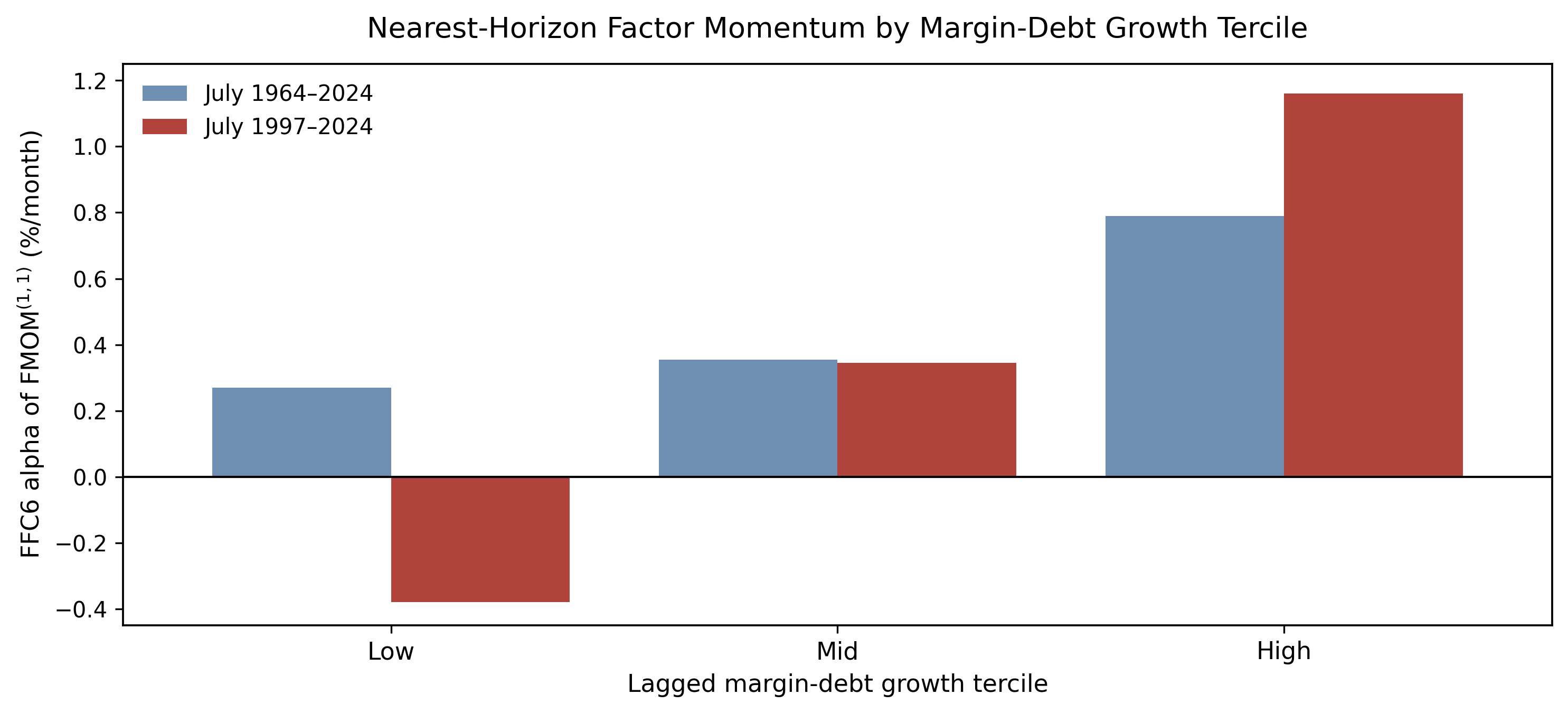
Figure 1: Factor momentum's risk-adjusted return, sorted by how fast margin debt grew the previous quarter. Chart recreated from Sun and Xia (2026), “Speculative Leverage and Factor Momentum,” Figure 2.
The effect fades as the momentum signal ages, concentrates in factors arbitrageurs find hardest to trade against, and shows up only in customers’ own borrowing, not in the cash sitting in their accounts or in hedge fund leverage.
Risk, uncertainty and credit conditions explain none of it. Once anomalies are published, their average returns decay but their momentum does not, which the authors read as “persistent speculative demand, financed with leverage and left uncorrected by arbitrageurs.” Leveraged performance chasing leaves a measurable footprint, and that footprint has timing value.
Sun, Weijian and Xia, Yu, Speculative Leverage and Factor Momentum. Available at SSRN: https://ssrn.com/abstract=7512099 or http://dx.doi.org/10.2139/ssrn.7512099
A Price the Market Declines to Adopt
India now settles its index derivatives on a closing auction price, and the futures market trades as though it only half believes it.
Since August 2026, India has priced the close of every derivative eligible stock through a twenty minute auction, and that price became the official settlement for index derivatives. The awkward part is that the published index is frozen by rule while the auction runs, so for roughly thirteen minutes a liquid futures market is valuing contracts against a number that is static by definition. When the auction price finally lands, futures shift only about a tenth of the way toward it, and nearly all of the remaining gap shows up in the futures basis instead.
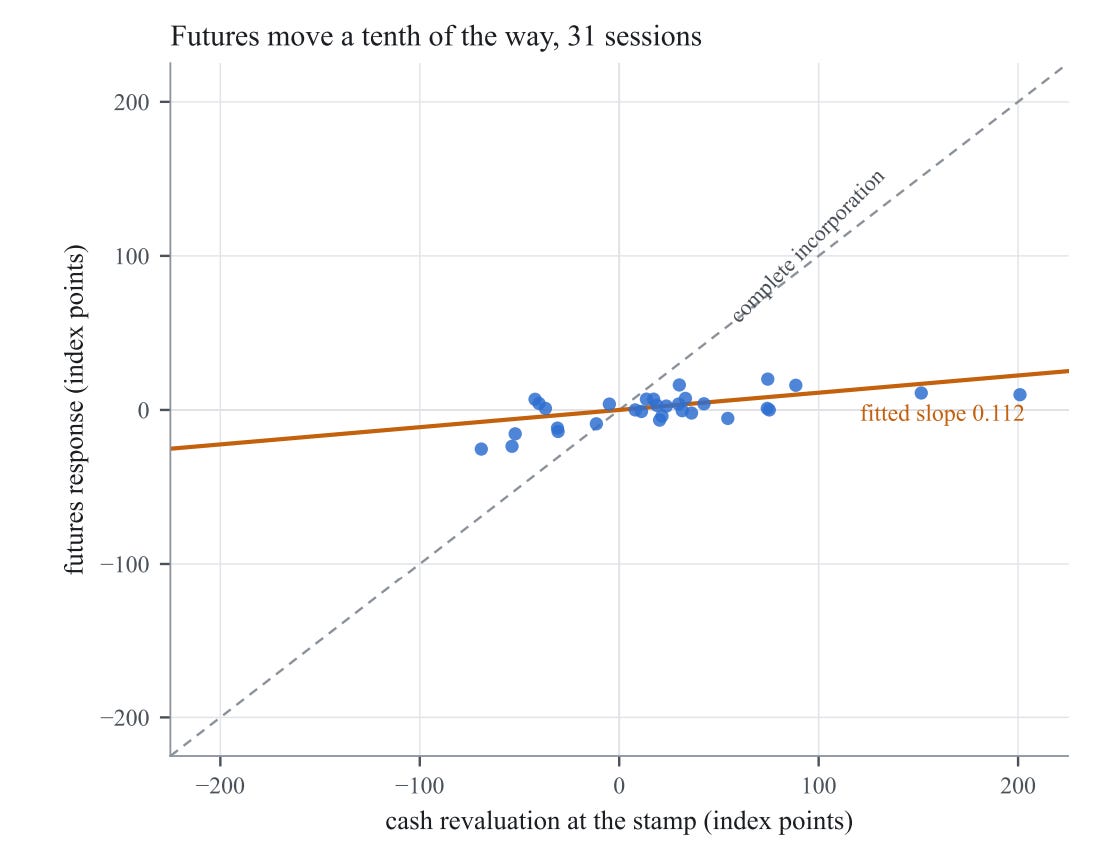
Figure 2: Each dot is one trading session. The dashed line is where futures would sit if they fully accepted the auction's price. But they sit on the flat line instead.
Part of the move is anticipated during the freeze, but even measured generously the futures market prices in at most half of the revaluation. The author's broader point is that this auction passes every recognized benchmark integrity test and adoption still fails, because a settlement price can “still be a price the referencing market does not use.” The practical read is that option payoffs and futures marks can disagree on the same index at the same instant, and only the settlement contract closes that gap.
Balas, Vijay, A Settlement Price the Market Declines to Adopt: Evidence from India's Closing Auction (September 21, 2026). Available at SSRN: https://ssrn.com/abstract=7502458 or http://dx.doi.org/10.2139/ssrn.7502458
When the Benchmark Is Risky
Swap rates sit below Treasury yields because the U.S. government, unlike the benchmark rates banks swap against, can actually default.
Since 2008, the fixed rate on interest rate swaps has sat below the yield on Treasuries of the same maturity. That ordering should be impossible, since Treasuries are meant to be the safest and most liquid asset in the market.
The authors argue the puzzle dissolves once you allow the U.S. government to be, in a small way, risky. A swap is tied to a benchmark index like the federal funds rate, and an index cannot default because nobody can own it. But a Treasury bond can. That asymmetry makes the swap the safer leg and drags its rate below the Treasury yield. Credit default swap premiums on U.S. debt, now roughly 100 times their pre-crisis level, move in step with these spreads.
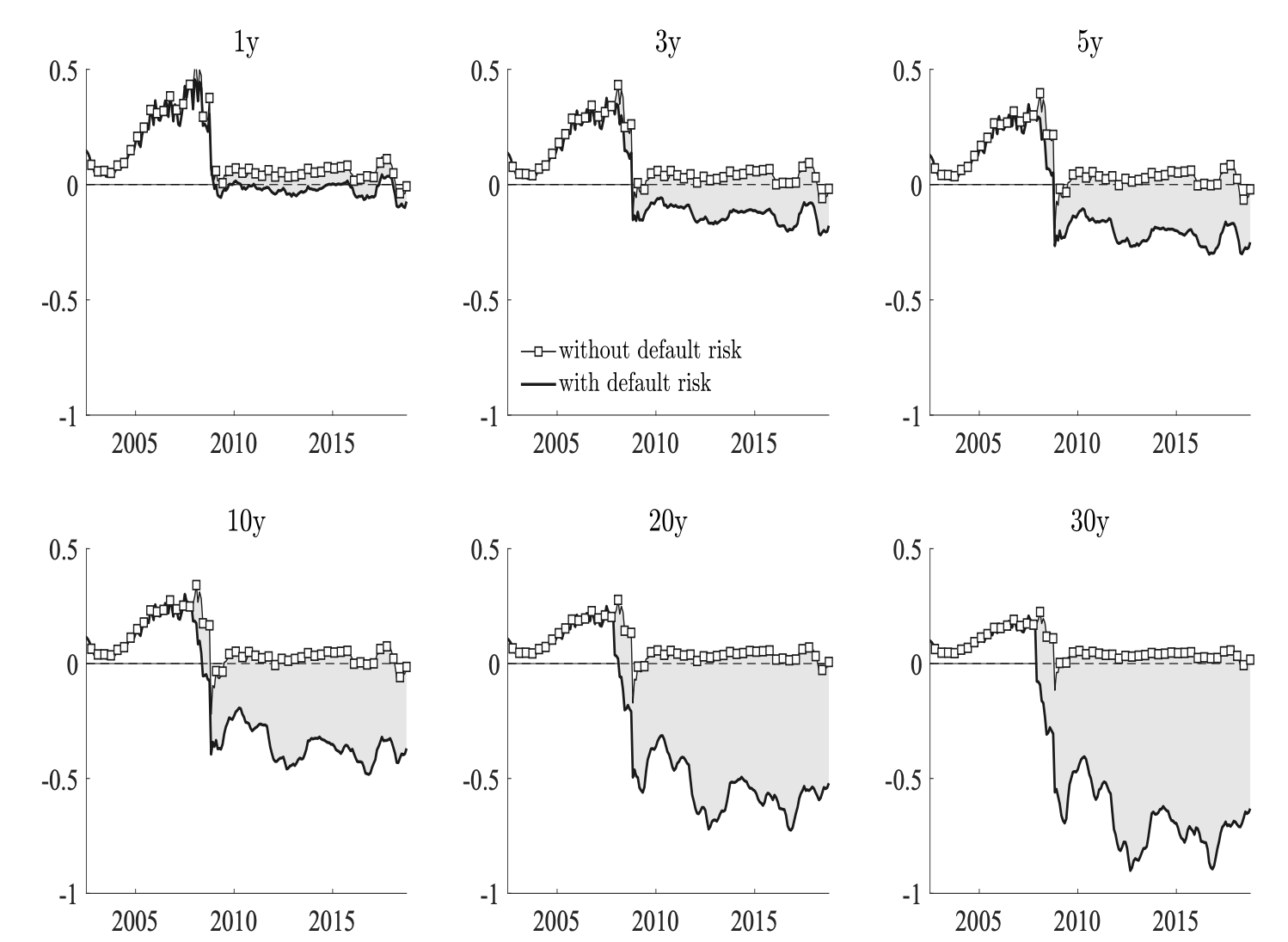
Figure 3: Model-implied OIS minus Treasury spreads at 30 years. The solid line includes U.S. default risk and turns sharply negative after 2008. The counterfactual without default risk (shaded) stays near zero. The gap between them is the sovereign risk premium.
Strip sovereign credit risk out of their model and spreads turn positive at every maturity. For investors, the risk-free rate is a modeling convenience rather than an observed price, and “the risk premium associated with it may be large.”
Augustin, Patrick and Chernov, Mikhail and Schmid, Lukas and Song, Dongho, Benchmark Interest Rates When the Government is Risky (November 2019). NBER Working Paper No. w26429, Available at SSRN: https://ssrn.com/abstract=3480299
One Institution, Many Voices
Mutual fund families are far less unified in how they vote than almost everyone assumed, and that internal splintering quietly weakens their grip on corporate boards.
The standard assumption, in academic work and in the current policy fight over proxy voting, is that when a giant like Vanguard or BlackRock casts a vote, the entire fund family speaks with one voice. This paper shows that assumption fails routinely, and has been failing since at least 2006. Internal disagreement looks trivial at roughly 4 percent of votes, but that figure is drowned out by routine proposals nobody argues about. On contested items, environmental and social proposals, and votes where proxy advisors recommend going against management, internal splits rise to the 15 to 20 percent range.
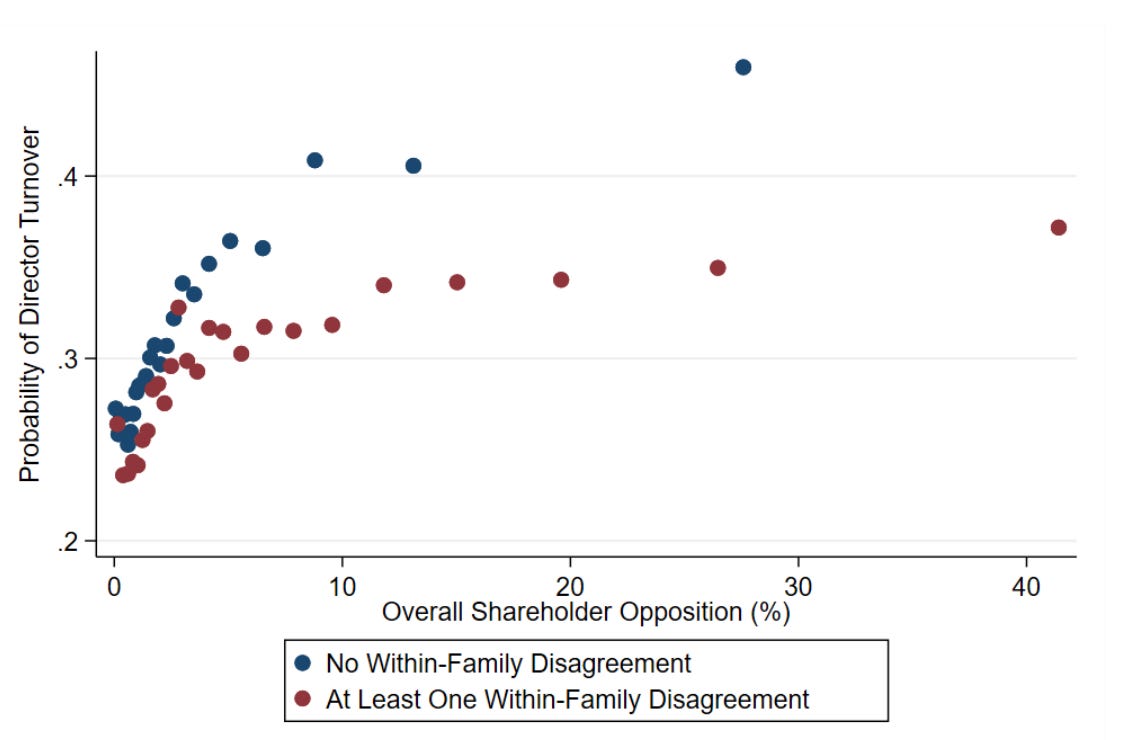
Figure 4: Same level of shareholder opposition, different outcome. When fund families vote as a bloc (blue), directors are far more likely to leave the board within three years. When families split internally (red), the pressure flattens out.
The consequence matters more than the measurement. When a family votes as a bloc, directors facing shareholder opposition are meaningfully more likely to leave the board. When the family splits, that pressure fades, a pattern the authors confirm using Vanguard's 2019 decentralization as a natural experiment. Funds that break ranks charge higher fees without better returns, yet institutional clients reward them with inflows. Pass through voting may give shareholders more choice and less actual influence.
Michaely, Roni and Ringgenberg, Matthew C. and Rubio, Silvina and Yi, Irene, Decentralized Voting in Mutual Fund Families (September 19, 2026). European Corporate Governance Institute – Finance Working Paper no. 1160/2026, Available at SSRN: https://ssrn.com/abstract=7491320 or http://dx.doi.org/10.2139/ssrn.7491320
This week for paid subscribers
Paid subscribers are getting a full replication of the FOMC cycle anomaly, reproduced on its original 1994 to 2013 window and extended through 2026 on the authors' exact specification, against survival thresholds fixed before the out-of-sample estimate was observed. The post traces how the even-week coefficient decays smoothly toward zero as newer data enters, and turns to the Treasury curve to test whether the Fed leakage mechanism was ever there to begin with. Python notebooks and data included.

Disclaimer: The content provided in this newsletter, "Alpha in Academia," is for informational and educational purposes only. It should not be construed as financial advice, investment recommendations, or an offer or solicitation to buy or sell any securities or financial instruments. Past performance is not indicative of future results. The financial markets involve risks, and readers should conduct their own research and consult with qualified financial advisors before making any investment decisions.
The interpretations, opinions, and analyses presented herein are those of the author and do not necessarily reflect the views of the original researchers, their institutions, or the full implications of the cited academic papers. While every effort is made to accurately represent the research discussed, readers should be aware that the summaries and interpretations may not capture the full scope or nuances of the original studies. The information contained in this newsletter is believed to be accurate and reliable at the time of publication, but accuracy and completeness cannot be guaranteed. The author and publisher accept no liability for any loss or damage resulting from reliance on the information provided.
This newsletter may contain links to external websites or resources. The author is not responsible for the content, accuracy, or reliability of these external sources.
By subscribing to or reading this newsletter, you acknowledge that you have read and understood this disclaimer and agree to hold the author and publisher harmless from any liability that may arise from your use of the information contained herein.