

Hello and welcome back to another paid post!
In 2019, Cieslak, Morse and Vissing-Jørgensen published a paper in the Journal of Finance arguing that the entire post-1994 US equity risk premium was earned during the “even” weeks of the Federal Reserve’s rate-setting cycle. The Wall Street Journal wrote it up. The Economist wrote it up. It became a fixture in trading-desk lore and in classroom arguments about market efficiency. This piece reproduces their finding on the original 1994 to 2013 sample, extends it through the end of 2026 on the exact specification they defined, and traces what happens to the pattern once we let fresh data into the estimation. The result is a case study in how a striking empirical claim moves through its own out-of-sample life, and in what a careful replication can teach even when the headline pattern does not survive.
Let’s dive right in.
What CMVJ found
Cieslak, Morse and Vissing-Jørgensen (CMVJ from here) made a specific claim about the timing of equity risk premia. Their construction is mechanical. Day 0 is the FOMC announcement day. Days minus one through three form week 0. Days four through eight form week 1. The counter runs out to week 6, at which point the next FOMC meeting resets it. Weeks 0, 2, 4 and 6 are even; weeks 1, 3 and 5 are odd. Their finding, from 1994 through the end of 2013, was that the market’s daily excess return averaged roughly twelve basis points on even-week days and essentially zero on odd-week days. Half the trading days, nearly all the return.
Figure 1 shows the image that made the paper famous. A hundred dollars invested in the US market only during even weeks tracks the buy-and-hold portfolio closely across two decades, with half the time in market.
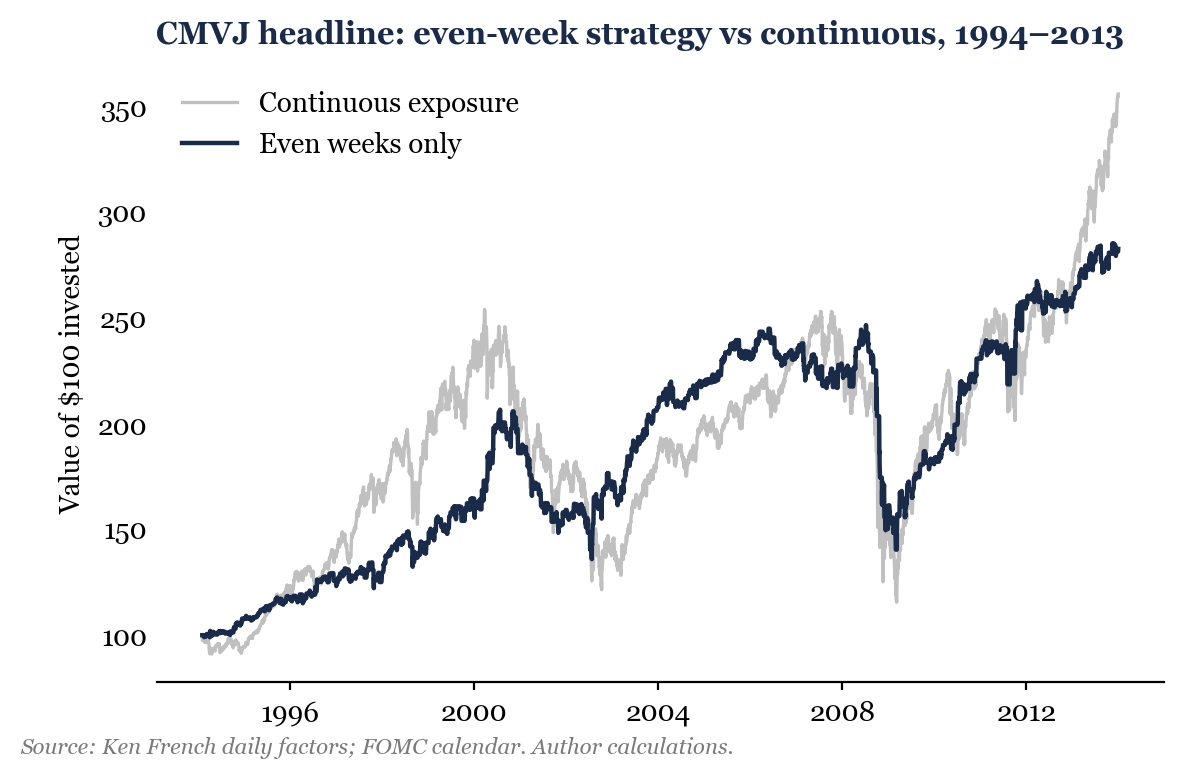
Figure 1. Value of $100 invested in the US market, 1994 to 2013. The even-week strategy captures nearly all the return of continuous exposure with half the time in market.
Their proposed mechanism was informational. The Federal Reserve’s Board of Governors historically held internal briefings on a biweekly cadence, and CMVJ argued that information from those briefings leaked selectively to sophisticated market participants on an even-week rhythm. Sophisticated investors, holding stock through the even-week window when good news was more likely to be revealed, earned a premium for absorbing that risk. It was a story that fit the pattern, fit the institutional detail, and was specific enough to be testable.