

Welcome back to another issue of Recent Academic Research!
Let’s get into it.
The Workers Behind the Numbers
Accounting’s information environment is shaped as much by rank-and-file employees as by the executives who sign the filings.
This review pulls together thirty years of research arguing that ordinary workers sit on both sides of corporate disclosure: they produce the numbers (as accountants, auditors, and operational staff whose skill and job stability determine reporting quality) and they consume them (as job seekers, negotiators, and insiders deciding whether to stay or leave). The authors organize the evidence around a Labor Life Cycle with four stages, from human capital development through turnover, and show that information frictions bite at each one.
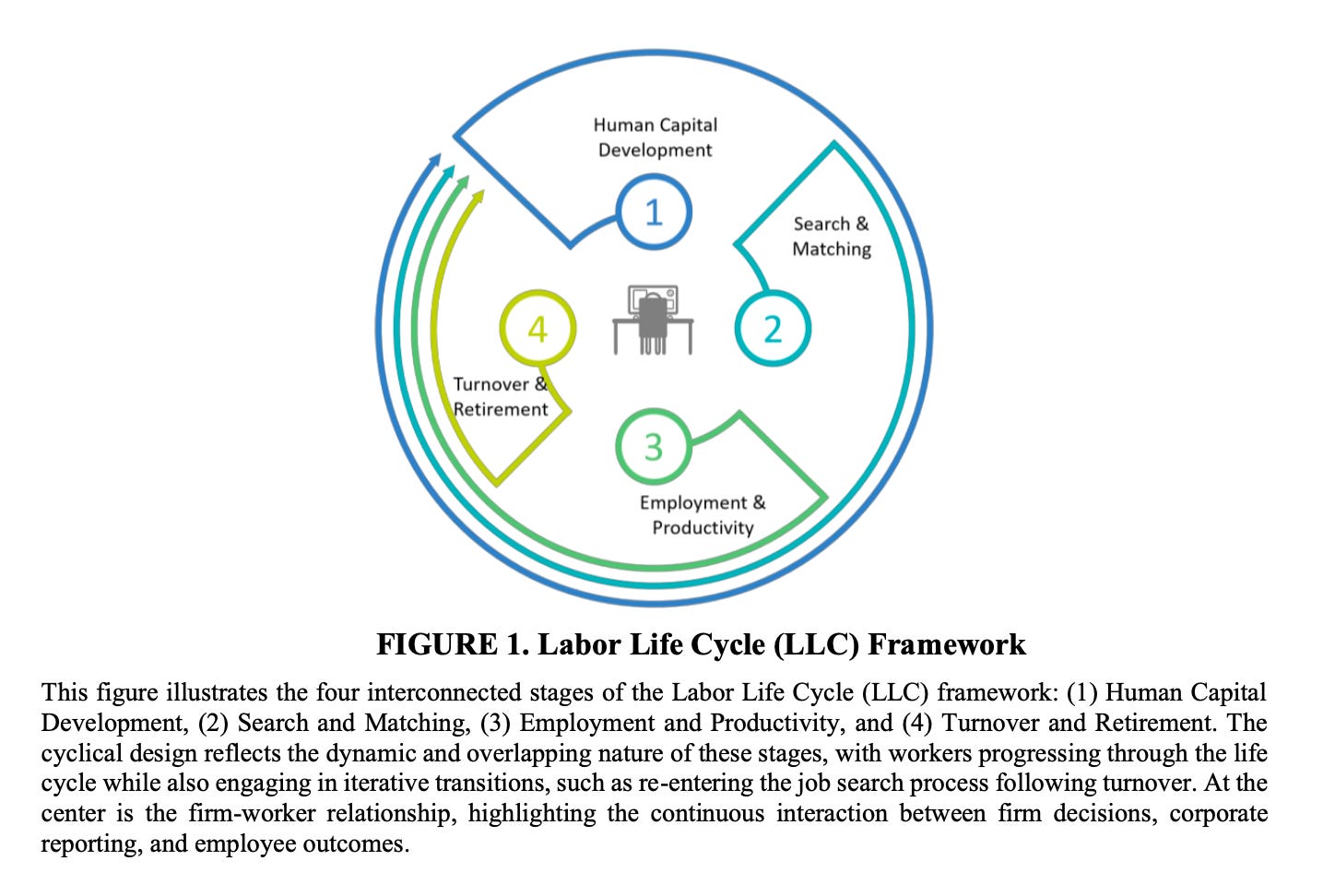
One concrete thread: in states that adopted the inevitable disclosure doctrine, which restricts where employees can jump to, firms reported less upward earnings management, because workers with fewer outside options pushed back less on aggressive accounting. The broader claim is a feedback loop between disclosure and the labor market that remains thinly tested empirically. For investors, the practical takeaway is that workforce metrics, retention, mandated human capital disclosures, and even Glassdoor data are not soft ESG filler but inputs into reporting quality itself, and worth reading alongside the financial statements rather than after them.
Barrios, John Manuel and Choi, Jung Ho and Deller, Carolyn and Pacelli, Joseph and Packard, Heidi A., Labor and the Corporate Information Environment: A Review. (June 18, 2026). Harvard Business School Working Paper No. 26-060, Harvard Business School Accounting & Management Unit Working Paper No. 26-060, The Wharton School Research Paper , HKU Jockey Club Enterprise Sustainability Global Research Institute Paper No. 2026/037, Available at SSRN: https://ssrn.com/abstract=6390718 or http://dx.doi.org/10.2139/ssrn.6390718
The Hidden Cost of Hard Regime Switches
Switching regime models on and off creates estimator jumps that posterior averaging almost entirely removes, at little cost to accuracy.
Regime-aware risk models typically pick one market state (calm, turbulent, expansion, contraction) and estimate volatility, correlations, or tail risk only from historical weeks that match. The problem is that a small shift in the classifier’s belief can flip the selected state and swap the entire estimation sample overnight, which the author calls sample gating. On transition weeks, covariance estimates jump 15 to 30 times their usual size, forcing portfolio weights to lurch and triggering risk-review flags 5 to 6 times a year.
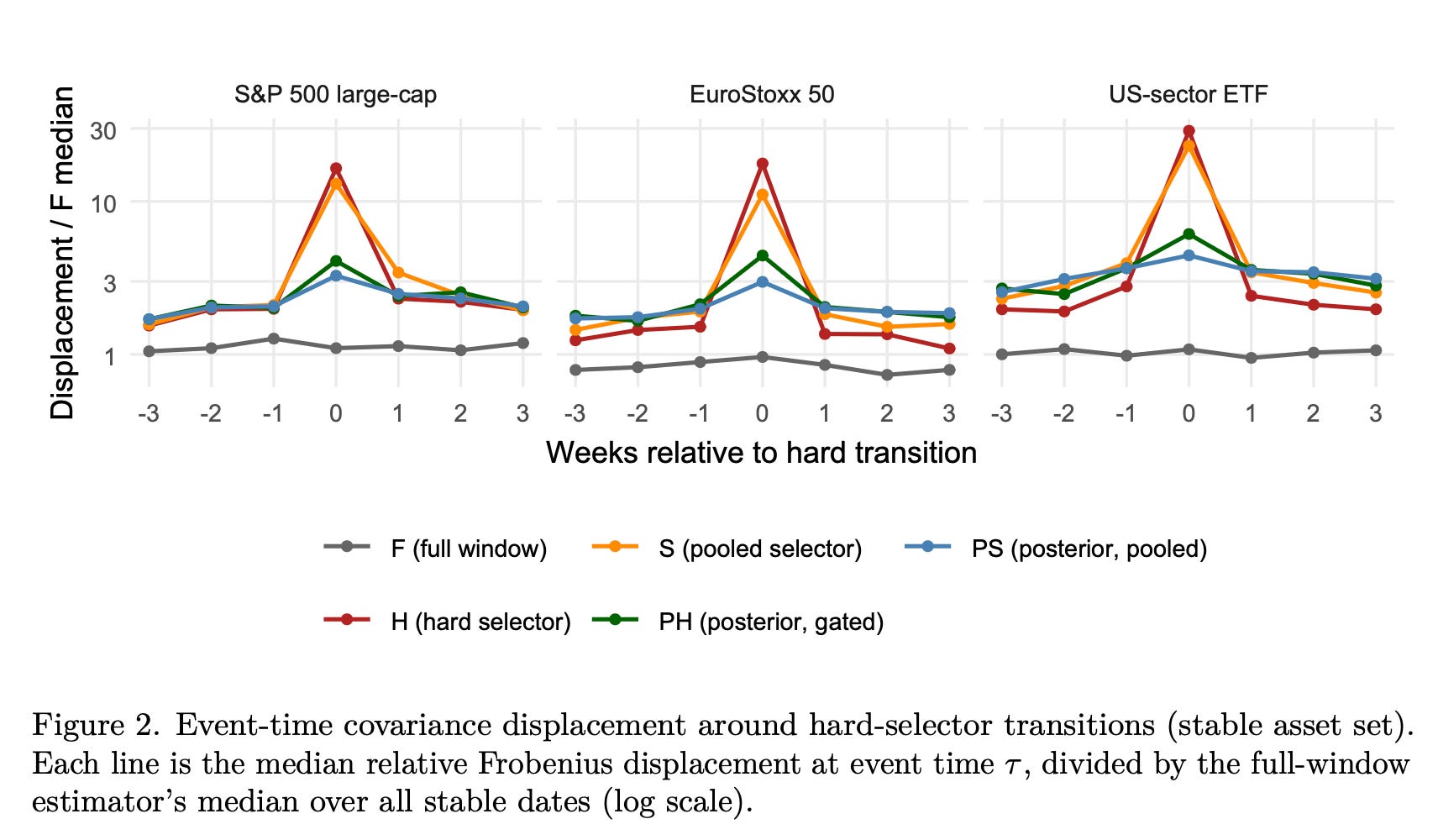
The fix is simple: instead of committing to one state, average the state-specific estimates using the classifier’s probabilities. Across S&P 500, EuroStoxx 50, and US sector ETF panels, this cuts transition jumps by 72 to 81 percent, lowers minimum-variance portfolio turnover by 23 to 30 percent, and improves risk-forecast loss in all nine panel-loss comparisons tested. For anyone running regime-based allocation or risk models, the takeaway is that the discrete on-off switch is doing real damage, and the smoother alternative is already sitting in the classifier’s own output.
Hydari, Syed Bashir, Sample Gating: Estimator Discontinuity under Latent-State Conditioning (September 28, 2026). Available at SSRN: https://ssrn.com/abstract=7538119 or http://dx.doi.org/10.2139/ssrn.7538119
The Credit Premium Shows Up for Work Five Days a Month
The entire credit risk premium in corporate bonds is earned in the first five trading days of each month.
Dickerson and Nozawa document something strange about how corporate bonds pay investors. Using every US corporate bond from 1997 to 2023, they find that roughly 73% of individual bond credit returns, 83% of the market credit premium, and 51% of the premia across 103 long-short bond factors are earned during the first five trading days of each month, a window that accounts for only about a quarter of trading days. On the remaining three weeks, credit returns are statistically indistinguishable from zero.
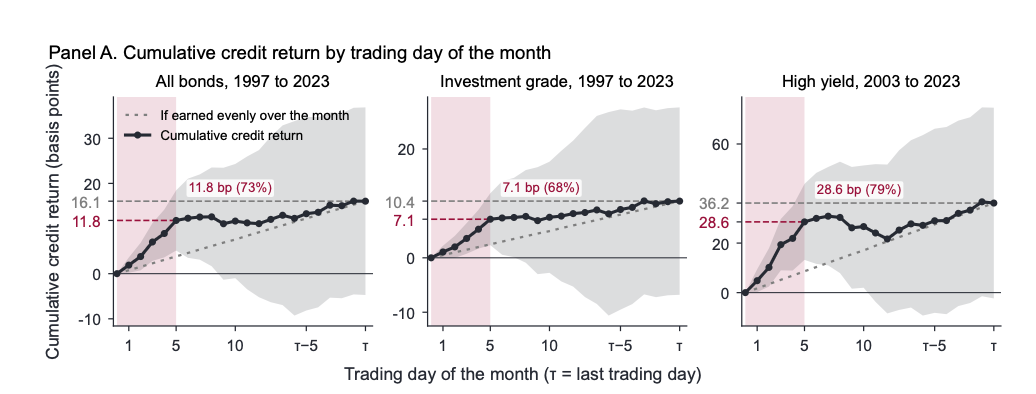
The pattern holds in both investment-grade and high-yield bonds, survives filters for illiquid or stale-quoted names, and shows up in credit default swaps as well. Even more striking, a simple one-factor bond CAPM explains 76% of the cross-sectional variation in factor returns during this window, versus 6% using full-month returns, which suggests the sprawling “factor zoo” is largely one credit premium wearing different costumes. For investors, the takeaway is that rebalancing timing is not neutral, and portfolios that reduce credit exposure early in the month may be systematically giving up the compensation they thought they were earning.
Dickerson, Alexander and Nozawa, Yoshio, Credit When it's Due: Corporate Bond Factors on a Schedule (September 25, 2026). Available at SSRN: https://ssrn.com/abstract=7524680 or http://dx.doi.org/10.2139/ssrn.7524680
When Futures Prices Break: Modeling the Oil Crash and Nickel Squeeze
A tractable options-pricing model explains how forced liquidation by delivery-constrained traders can push oil futures below zero and nickel futures to $100,000.
Zimbidis and Sircar tackle two of the strangest commodity-futures events in recent memory, the April 2020 WTI collapse to −$37.63 and the March 2022 LME nickel squeeze to $101,365, using a single framework. Their insight is to split traders into those who can actually take physical delivery (producers, refiners, warehouses) and those who cannot (most financial participants), and model the cost that unlicensed traders bear when they are forced to close positions into a thin pool of counterparties. That cost is a “roll option” whose payoff depends on the observed price it helps determine, which creates a feedback loop and a nonlinear pricing equation. Remarkably, the whole thing collapses into a Margrabe exchange-option formula with one scalar equation to solve.
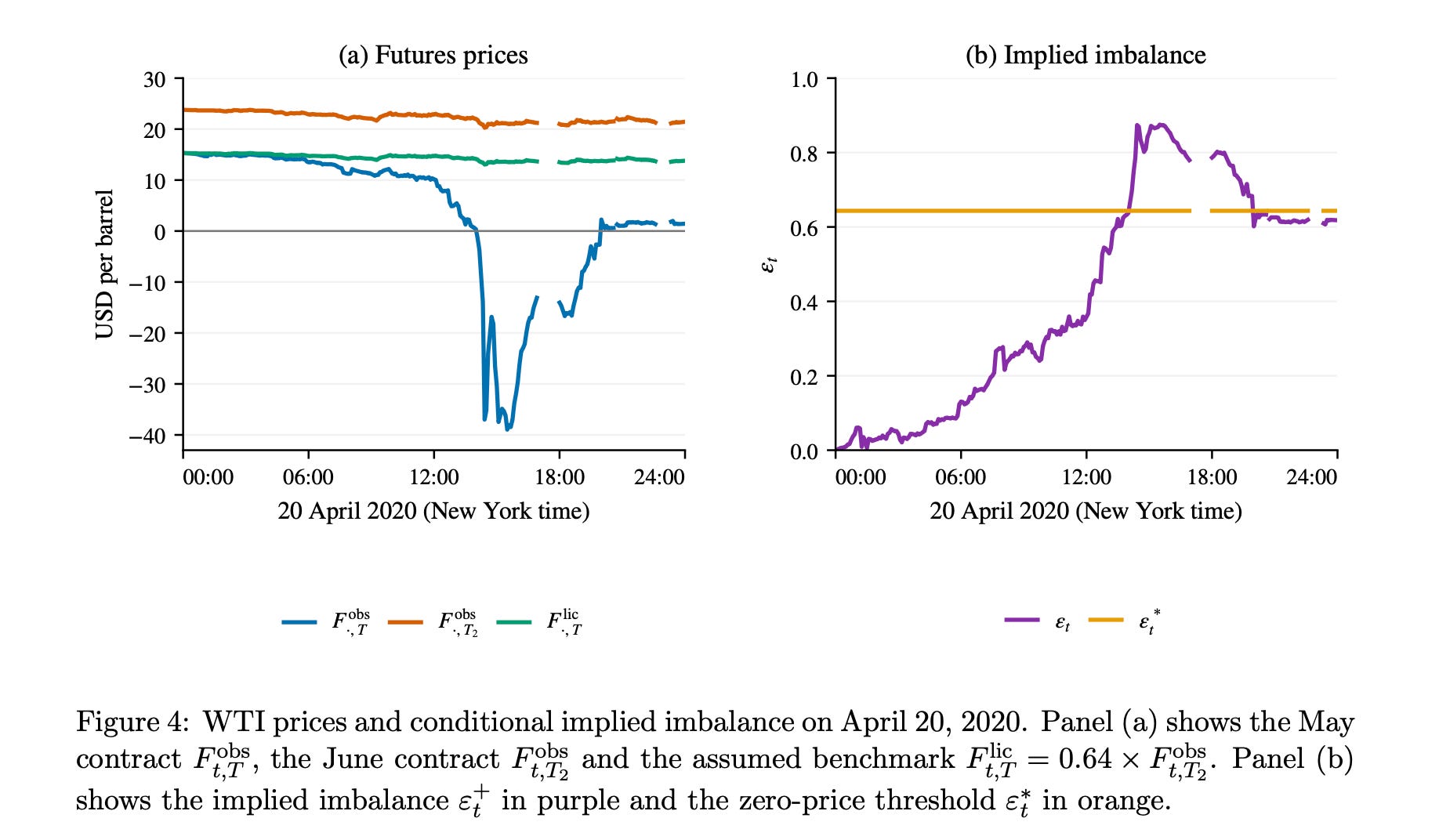
Backing out the implied imbalance from market data gives roughly 87% for WTI at the April 20 low and 93% for nickel at the March 8 high. The practical takeaway is that extreme futures prints near expiry are not always “fundamentals breaking”, they can be the mechanical signature of who is allowed to stay in the contract and who is not.
Sircar, Ronnie and Zimbidis, Iosif, Negative Oil & Nickel Squeeze: A Feedback Model for Extreme Commodity Futures Prices (September 30, 2026). Available at SSRN: https://ssrn.com/abstract=7546838 or http://dx.doi.org/10.2139/ssrn.7546838
This week for paid subscribers
Paid subscribers are getting a full deep dive of the S&P 500 inclusion effect anomaly, reproduced on its original historical window and extended through 2024 on the author’s exact specification, against survival thresholds fixed before out-of-sample tests were observed. The post traces how the classic price-pressure spike decayed smoothly toward zero in the 2010s, and turns to the 2020s run-up to test whether the index demand mechanism or a false revival is actually behind it. Python notebook and data included.

Disclaimer: The content provided in this newsletter, “Alpha in Academia,” is for informational and educational purposes only. It should not be construed as financial advice, investment recommendations, or an offer or solicitation to buy or sell any securities or financial instruments. Past performance is not indicative of future results. The financial markets involve risks, and readers should conduct their own research and consult with qualified financial advisors before making any investment decisions.
The interpretations, opinions, and analyses presented herein are those of the author and do not necessarily reflect the views of the original researchers, their institutions, or the full implications of the cited academic papers. While every effort is made to accurately represent the research discussed, readers should be aware that the summaries and interpretations may not capture the full scope or nuances of the original studies. The information contained in this newsletter is believed to be accurate and reliable at the time of publication, but accuracy and completeness cannot be guaranteed. The author and publisher accept no liability for any loss or damage resulting from reliance on the information provided.
This newsletter may contain links to external websites or resources. The author is not responsible for the content, accuracy, or reliability of these external sources.
By subscribing to or reading this newsletter, you acknowledge that you have read and understood this disclaimer and agree to hold the author and publisher harmless from any liability that may arise from your use of the information contained herein.
The credit one caught my eye. 73% of the bond returns in the first five days of the month is the same shape I see at trade level: most of the value shows up early, and if you're late you're holding a different trade. My question for the paper would be costs. Does it survive actually being positioned for those five days every month? Corporate bonds are not cheap to trade.
Read together, three of these papers describe one failure: a hard binary sitting where everyone assumes a smooth curve. In sample gating, a classifier flips from calm to turbulent and swaps the whole estimation window overnight. In oil and nickel, a delivery constraint flips traders from "can stay" to "must leave" and swaps the whole pool of counterparties. Hydari's fix, weighting by probability instead of committing, hints at a market analogue: exits that phase in by degree rather than all at once should produce smaller cliffs than an 87% or 93% imbalance. The bond result comes at it from the other side. If the premium arrives on a calendar, the regime worth conditioning on may simply be the date, a variable no classifier is watching.