

Reviewed and updated 28 July 2026
Hello and welcome back to another paid post!
Today we are going to take one of the most repeated headlines in all of commodity markets and ask whether there is any money in doing the exact opposite. The idea is old and intuitively appealing: The fast money crowds into a trade, the trade gets stretched, and the crowd, as crowds tend to, eventually gets carried out. If that story is true, then the crowd’s own positioning should tell you when to fade it.
Let’s dive right in.
The Cheat Sheet the Government Publishes Every Friday
Every week, the Commodity Futures Trading Commission (CFTC) releases something called the Commitments of Traders (COT) report, and it is one of the closest things retail traders have to seeing the other side of their own hand. The report takes every major futures market and sorts the people holding positions into buckets, based on who they actually are and why they are there. Two of those buckets matter for us, and the whole strategy lives in the tension between them.
The first is Managed Money. In the CFTC’s disaggregated report, this category includes registered commodity trading advisers and commodity pool operators, along with unregistered funds identified by the Commission. It is a reporting category, not proof that every position follows the same trend strategy. Here I test its aggregate net position without assigning a motive to each trader.
The second bucket is Producer/Merchant/Processor/User. These are entities predominantly engaged in producing, processing, packing, or handling the physical commodity and using futures to manage commercial risk. Their aggregate position often sits across from speculative demand, but the report does not identify the motive for each trade.
The distinction still gives us a useful empirical question. Managed Money is a reportable speculative category; Producer/Merchant/Processor/User is tied to commercial activity. Their aggregate net positions can lean against each other, but the labels do not tell us which side is informed, patient, early, or late. The test below asks only whether an extreme Managed Money position was followed by a profitable contrarian portfolio in these three metals.
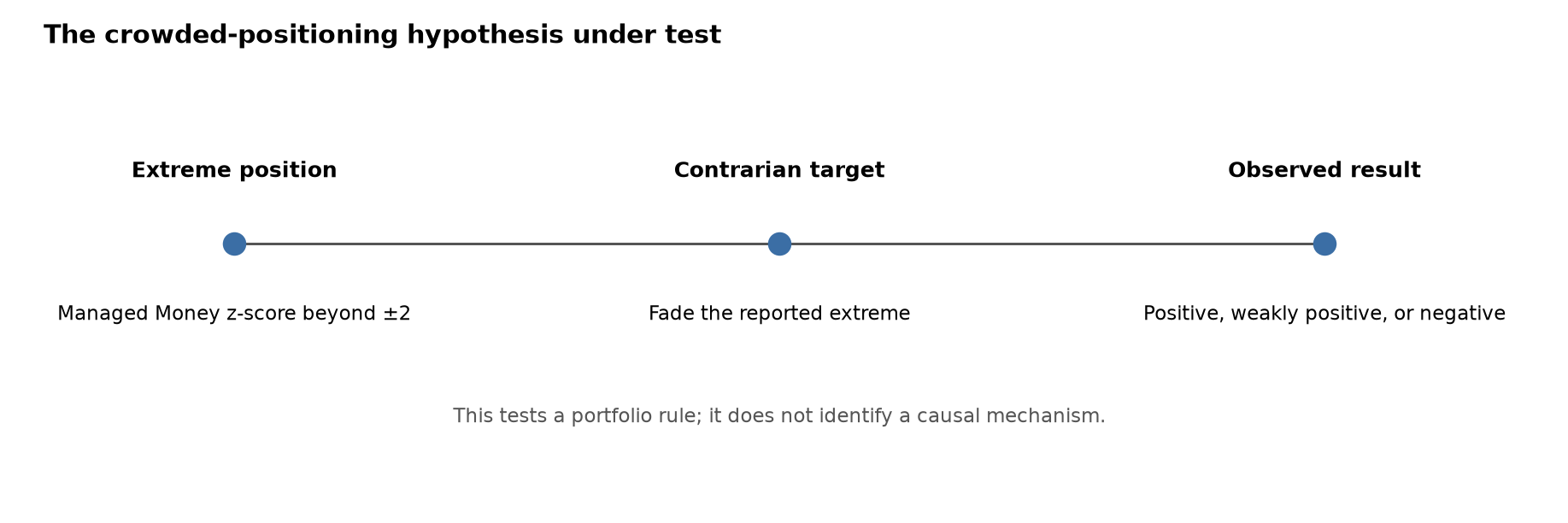
The hypothesis in one line: an extreme speculative position might coincide with an exhausted trend. That is the proposition under test, not something the category labels establish.
That gives us a clean question. When Managed Money’s net position is unusually high, fade it short; when it is unusually low, fade it long. Then ask whether the resulting portfolio was positive after the report could conservatively have become actionable. The outcome can support or reject the rule in this sample, but it cannot by itself identify why prices moved.