

Hello and welcome back to another paid post!
Reviewed and updated 29 July 2026
Today I will test whether a time-valid renewable momentum signal adds anything to a simple hour-of-day model for ERCOT’s HB_NORTH spread. Let’s dive right in.
Recall
Let’s review our baseline model from our first look at the Texas power grid from two weeks ago. By simply selling power in the Day-Ahead Market and buying it back in Real-Time every single hour of the year, we uncovered a persistent, structural average spread of $0.93 per megawatt-hour. It was a respectable baseline, but trading every single hour of the year regardless of external signals is a heavy-handed tactic. In the real world, the friction of execution can quickly erode those theoretical gains. To evolve this baseline into something truly institutional, we have to look at how sophisticated desks trade the physical shape of the grid rather than just reading a static clock.
This transition from a naive clock to a selective, signal-driven framework is present in energy economics. In their seminal paper analyzing wholesale electricity markets, researchers Akshaya Jha and Frank Wolak discussed how financial virtual bids act as an essential arbitrage mechanism to align forward and spot prices. They examined the boundaries of market efficiency and concluded that convergence bidding profitability is structurally bound by transaction costs. Specifically, they noted in their conclusion that purely financial forward market trading can improve the operating efficiency of short-term commodity markets by optimizing thermal generation dispatch and reducing total variable production costs.
I use this market-efficiency question to test a narrower idea: whether a three-hour ramp in a posted system-wide wind series adds useful information beyond hour-of-day effects.
Jha, A., & Wolak, F. A. (2013). Testing for market efficiency with transactions costs: An application to convergence bidding in wholesale electricity markets. Stanford University. https://arefiles.ucdavis.edu/uploads/filer_public/2014/03/27/caiso_vb_draft_v8.pdf
Data Architecture
Before constructing a predictive engine, we must address the data required to blend financial prices with the physical state variables of the grid. Our asset universe consists of the same Day-Ahead Market (DAM) and Real-Time Market (RTM) as part one’s, using 2025’s data and HB_North prices.
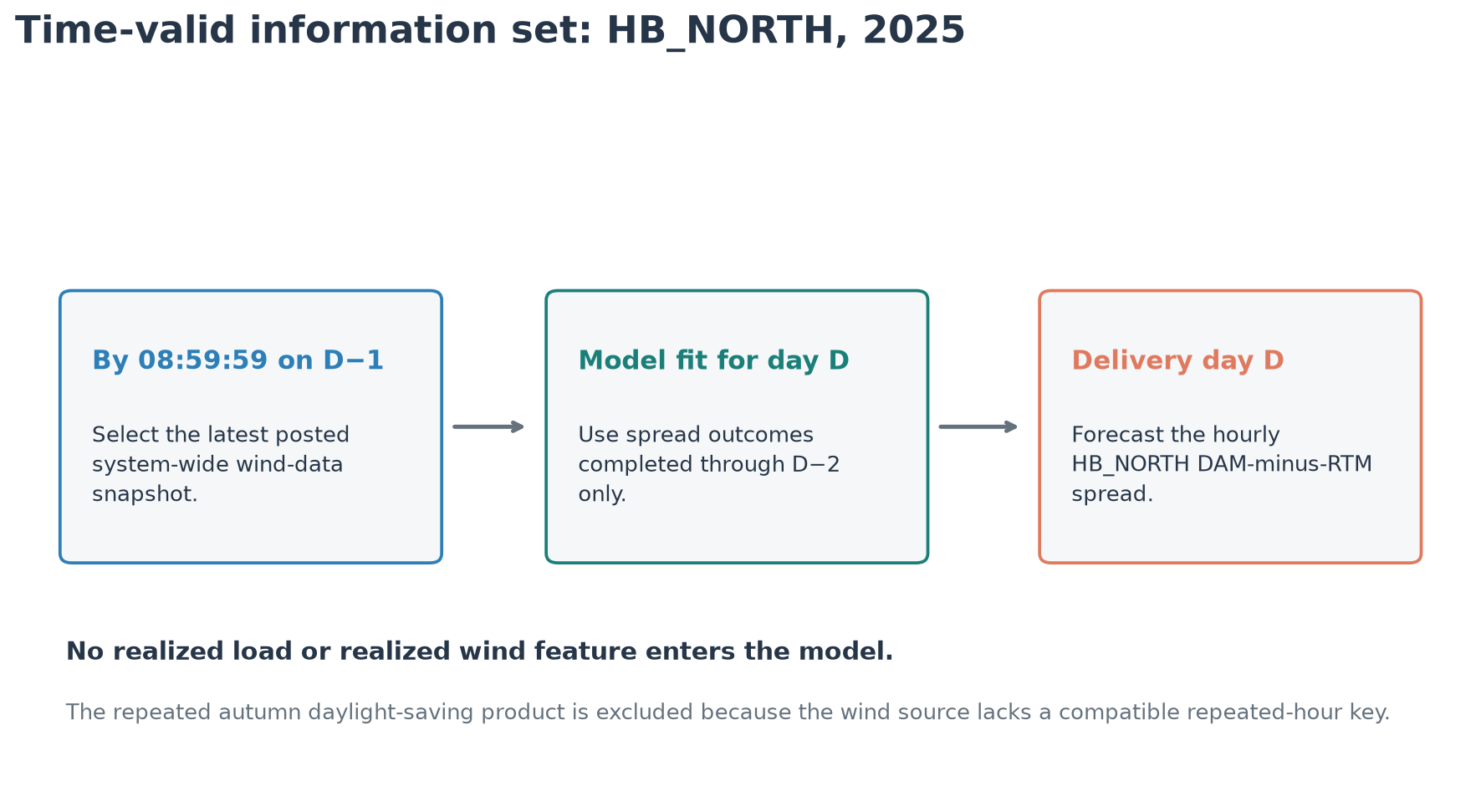
I use 8,759 unique 2025 HB_NORTH delivery-date and hour-ending products. For each product, I select the latest wind-data snapshot posted by 08:59:59 on the calendar day before delivery, exclude the repeated autumn daylight-saving product, and use no realized load or realized wind feature.
Feature Engineering and Grid Physics
To test the physical signal rather than assume it, I compare an hour-of-day reference with three otherwise identical models. Each additional model uses one posted ERCOT system-wide wind field and its preceding three-hour ramp.