

Welcome back to another issue of Recent Academic Research!
Let’s get into it.
At-the-Money Vol Isn’t Enough
Bond convexity, long treated as a tidy curve-level correction, turns out to depend materially on the volatility skew the market is pricing.
Piterbarg and Van Der Helm rebuild the definitions of term premium and bond convexity from a trading strategy rather than postulating them, deriving the lifetime convexity value of holding a long bond financed at the short rate as a direct, measurable quantity. The payoff of this rigor shows up when they feed the framework real market data. In a quasi-Gaussian model calibrated only to at-the-money swaption volatility, 30-year convexity comes in around 108bp; once the model is recalibrated to also match the market’s volatility skew, that same convexity rises to roughly 140bp, with the term premium shifting by a comparable amount.
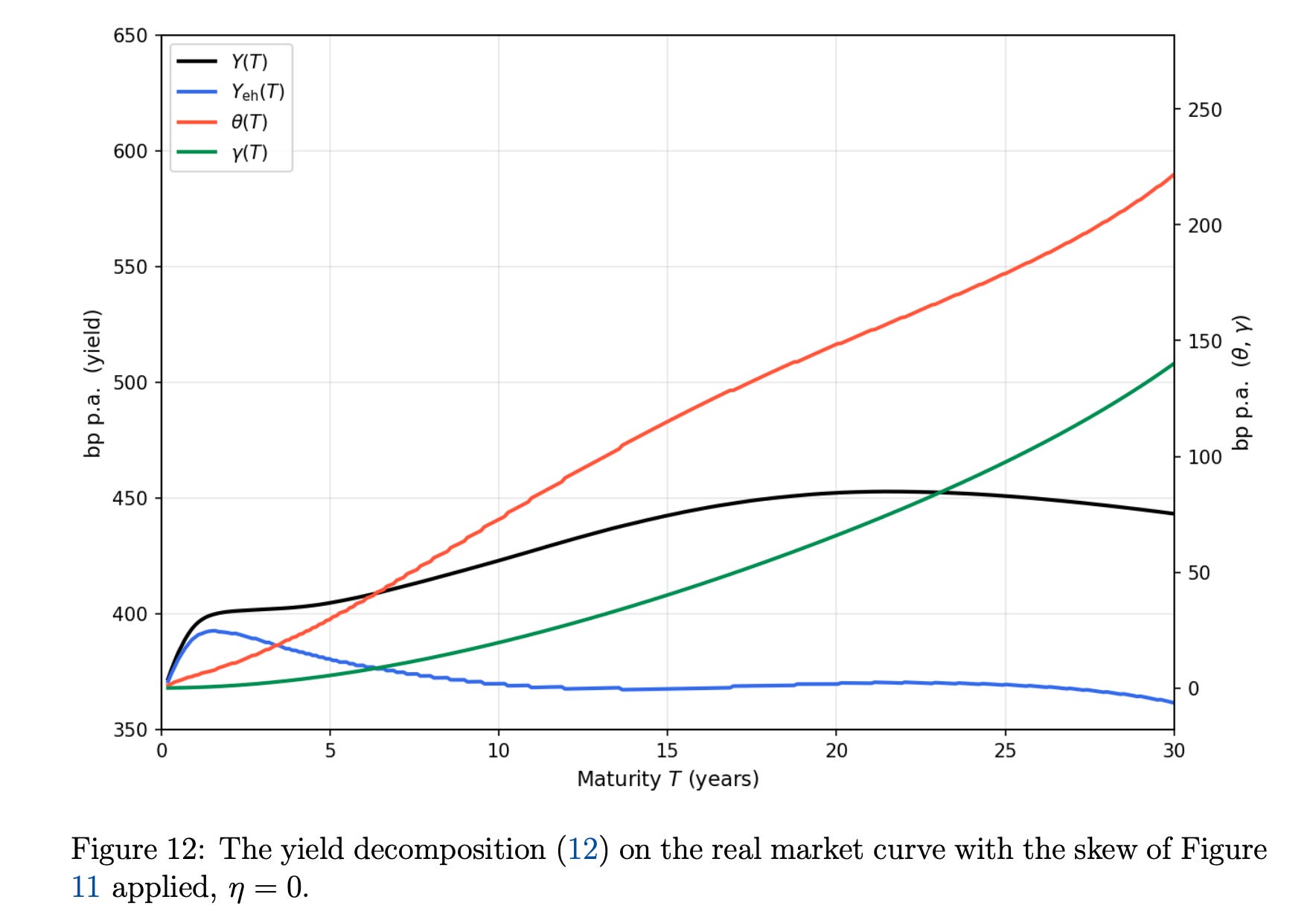
In other words, the standard textbook convexity correction, built from at-the-money vol alone, misses effects of the same order as the correction itself. For fixed income investors, this means long-end relative value calls, from “is the 30-year rich or cheap” to term-premium estimates driving duration allocations, depend on how the skew is treated, not just the level of implied vol.
Piterbarg, Vladimir and Van der Helm, Wouter, Term Premia and Bond Convexity: Sliding Curves, Trading Strategies, and Model Impact (November 06, 2026). Available at SSRN: https://ssrn.com/abstract=7687582 or http://dx.doi.org/10.2139/ssrn.7687582
When Analyst Reports Flow, Markets Move
Analyst reports that read as a connected argument, not a stack of disjoint facts, generate materially more trading and tighter markets, and that value is holding up even as generative AI erodes writing quality.
Gu, Xue, and Zhang study 331,404 analyst reports from 2018 to 2024, scoring each one on cohesion (whether successive sentences semantically link into a unified narrative, separate from simple readability or brevity). A one-quartile jump in cohesion lifts abnormal trading volume around the report’s release by roughly 10%, with the effect strongest exactly where it should matter most, when uncertainty is high, the underlying content is complex, or the analyst is making a bold or negative call. Firms covered by more cohesive reports subsequently show lower return volatility and narrower bid-ask spreads, pointing to a real improvement in how information gets priced in.
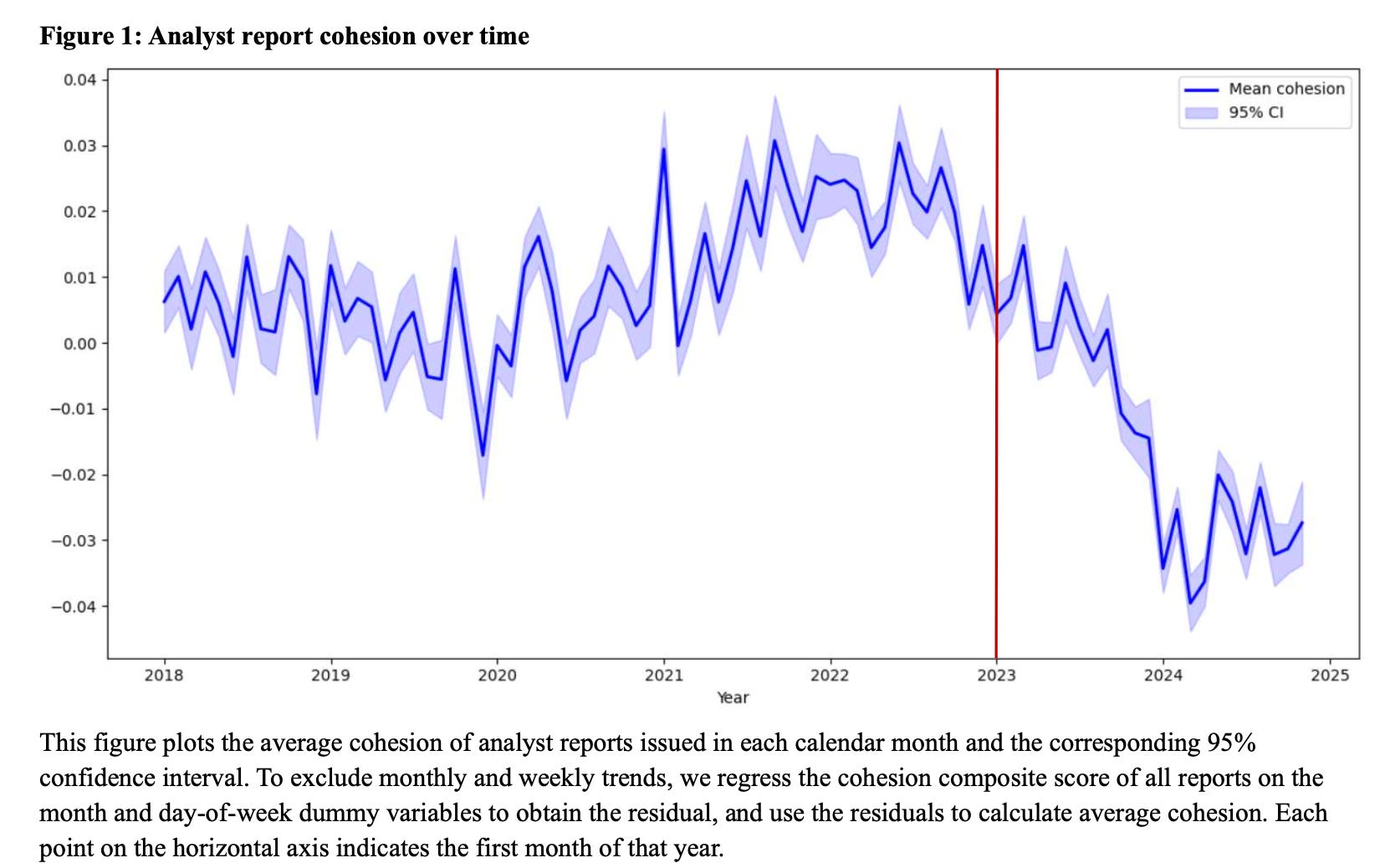
Yet even as cohesion has dropped, investors continue to reward it just as much, suggesting the market pays for narrative integration that AI has not learned to replicate.
Gu, Zhaoyang and Xue, Jian and Zhang, Qian, When It Makes Sense: Text Cohesion of Analyst Reports (April 07, 2025). Available at SSRN: https://ssrn.com/abstract=7686544 or http://dx.doi.org/10.2139/ssrn.7686544
Skew Is Where the Signal Lives
A new “break-even” volatility framework reveals where FX options are genuinely cheap or rich, with the real edge hiding in skew.
Pozzetti and Natividade tackle a stubborn problem in FX options: implied volatility alone is a poor fairness check, because two options with identical implied-minus-realized spreads can have wildly different economics once path dependence and gamma timing are accounted for. Their fix is break-even volatility, the implied level that would zero out a delta-hedged option’s expected profit and loss over a one-month holding period. Ranking options by how far quoted vol sits from this threshold, they find the signal is strongest in skew (risk reversals), with term structure a secondary driver and butterflies contributing little.
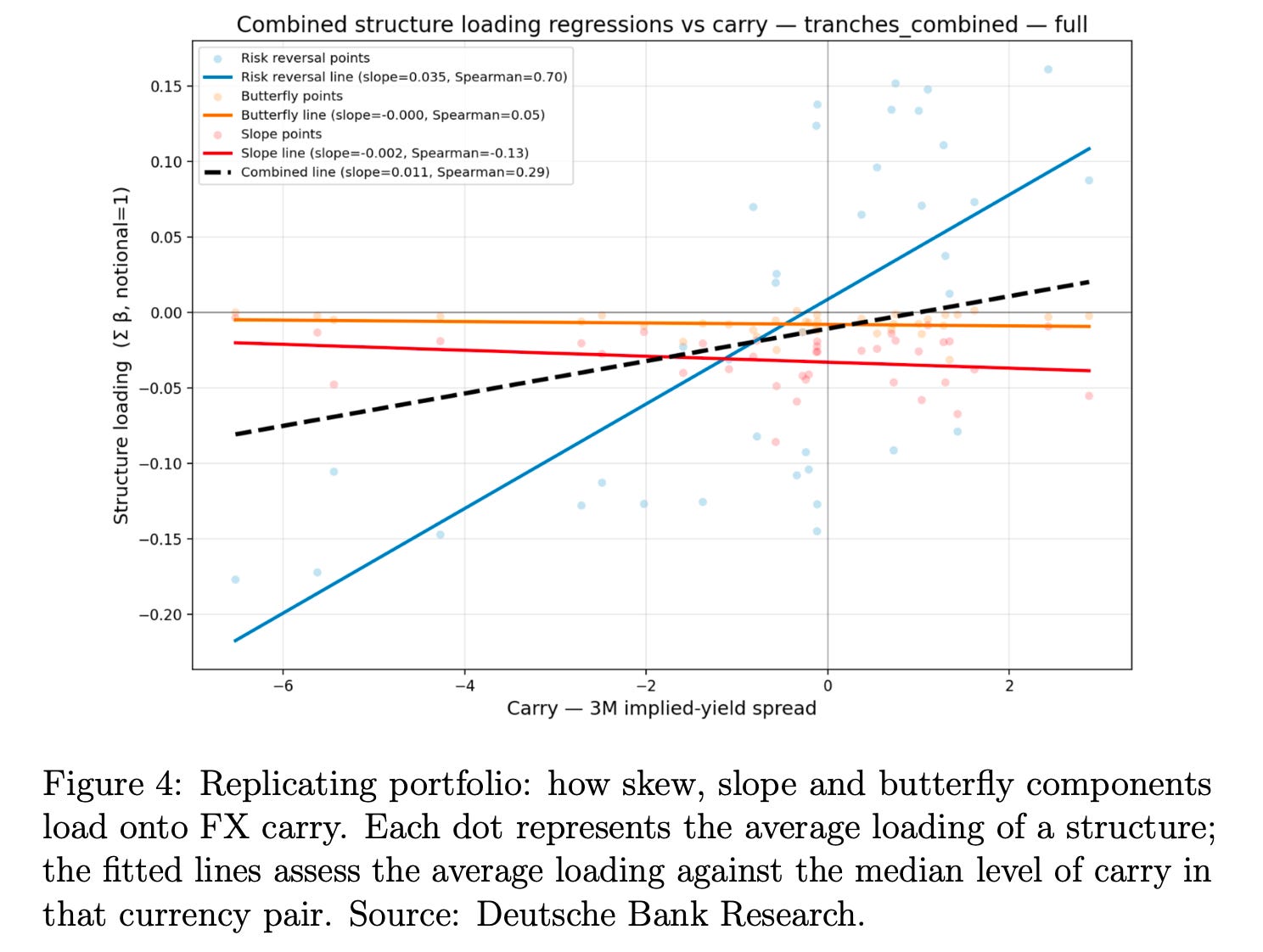
Trading the raw surface signal directly is prohibitively expensive, so they replicate it using liquid risk reversals, butterflies, and calendar spreads via constrained ridge regression, cutting estimated transaction costs by roughly 40% with no loss of alpha. For investors, this reframes relative value in FX options away from naive vol-premium harvesting toward a cost-aware, skew-centric view of where the surface is actually mispriced.
Pozzetti, Francesco and Natividade, Caio, Breaking Even with FX Volatility: Forecast Break-even Value and Cost-aware Replication (October 08, 2026). Available at SSRN: https://ssrn.com/abstract=7683321 or http://dx.doi.org/10.2139/ssrn.7683321
The Capital-Risk Diversification Frontier
A long-standing tension in portfolio construction (spreading your capital vs. spreading your risk) turns out to have a clean, parameter-free resolution sitting on an unexploited frontier.
Bajo Traver points out that diversification is measured in two incompatible currencies: capital (how evenly the budget is spread) and risk (how evenly volatility contributions are spread). Equal weighting maxes out the first but lets the most volatile assets dominate risk; equal risk contribution (ERC) maxes out the second but piles capital into the least volatile assets. Measuring both on the same scale (the effective number of assets), he constructs a frontier of all attainable combinations and shows that popular compromise rules (convex mixes of equal weight and ERC, alpha risk parity) sit strictly inside it, leaving more than 10% of the attainable capital diversification unused at the 2019 peak for euro-area sovereigns.
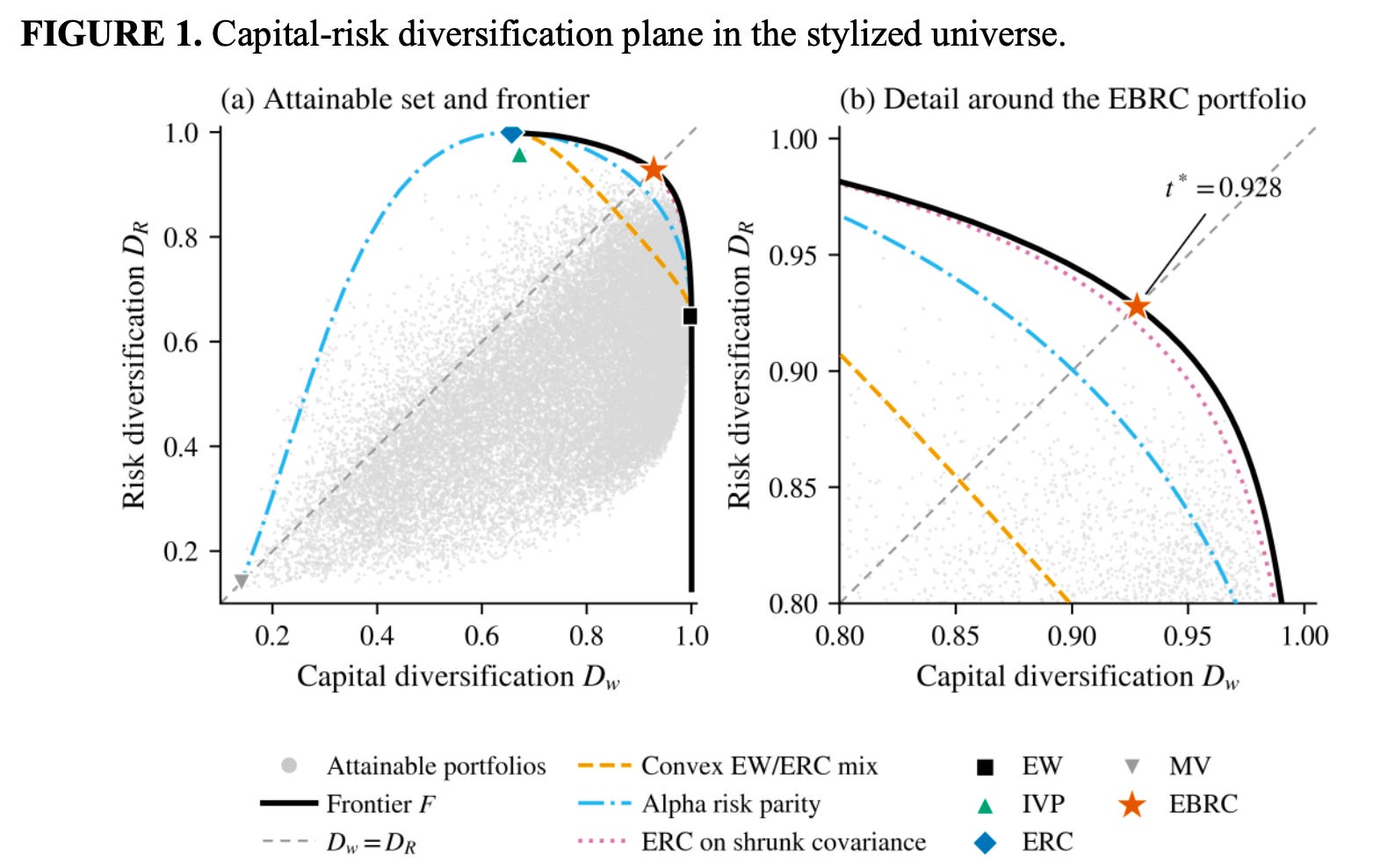
His Entropy-Balanced Risk Contribution portfolio reaches the frontier’s fixed point without any tuning parameter, and matches or beats tuned risk-parity variants out of sample in sovereign bonds. For allocators, this gives a diagnostic: how much of your portfolio’s concentration is imposed by the universe you invest in, and how much your rule is quietly adding.
Bajo Traver, Mario, The Capital-Risk Diversification Frontier (November 01, 2026). Available at SSRN: https://ssrn.com/abstract=7685685 or http://dx.doi.org/10.2139/ssrn.7685685
Securitizing the AI Boom
The first wave of GPU-backed securitization is imminent, and whether these deals survive depends less on headline chip counts than on contracted rent, fixed hosting costs, and enforceable asset rights.
Feng and Meng build a cash-flow model for a GPU-backed securitization, using September 2026 public data (cloud rental quotes from CoreWeave, AWS, Lambda, RunPod and Nebius, executed H100 and H200 secondary-market prices, and recent CoreWeave, Nscale, Lambda and Nebius loan facilities) to simulate 12,000 paths of senior and mezzanine losses. Under baseline conditions, expected principal loss is just 0.09% for senior notes and 9.2% for mezzanine. Under a moderate commercial stress (achieved rents falling from 75% to 72% of public quotes, fixed costs rising from 12% to 12.5%), senior loss jumps to 0.43% and mezzanine to 21.3%.
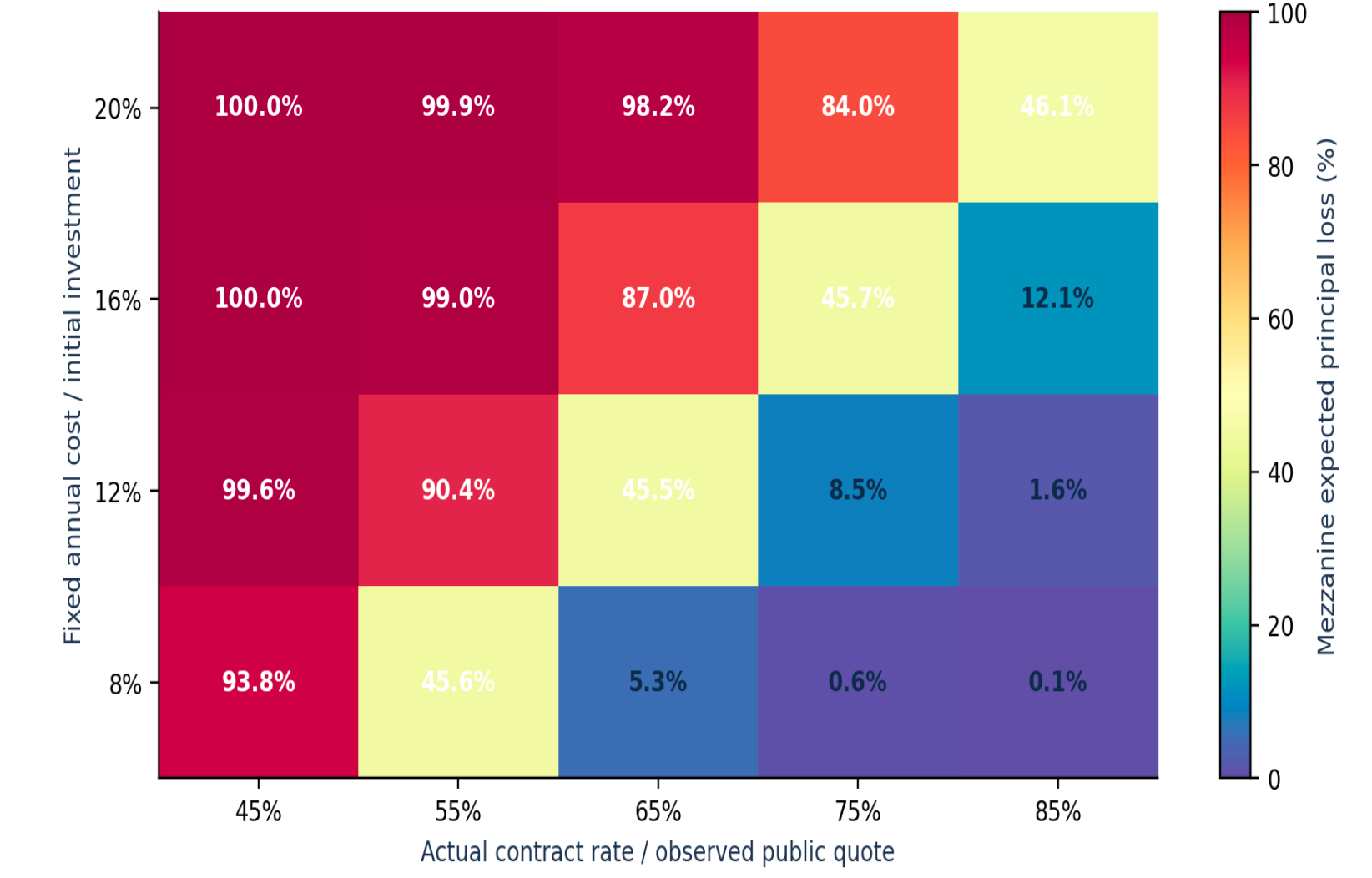
Even in the baseline, 98.6% of paths require a maturity extension beyond the four-year contractual term, meaning mezzanine investors rarely get paid on time. For allocators eyeing AI-infrastructure credit, the message is that the collateral works only inside a narrow band of rental realization and operating cost, and legal control over the physical equipment matters as much as the advertised spread.
Feng, Xuan, GPU-Based Securities: An Underwriting Framework for AI Compute Securitization (September 12, 2026). Forthcoming in the Journal of Alternative Investments, Available at SSRN: https://ssrn.com/abstract=7684544 or http://dx.doi.org/10.2139/ssrn.7684544
Disclaimer: The content provided in this newsletter, “Alpha in Academia,” is for informational and educational purposes only. It should not be construed as financial advice, investment recommendations, or an offer or solicitation to buy or sell any securities or financial instruments. Past performance is not indicative of future results. The financial markets involve risks, and readers should conduct their own research and consult with qualified financial advisors before making any investment decisions.
The interpretations, opinions, and analyses presented herein are those of the author and do not necessarily reflect the views of the original researchers, their institutions, or the full implications of the cited academic papers. While every effort is made to accurately represent the research discussed, readers should be aware that the summaries and interpretations may not capture the full scope or nuances of the original studies. The information contained in this newsletter is believed to be accurate and reliable at the time of publication, but accuracy and completeness cannot be guaranteed. The author and publisher accept no liability for any loss or damage resulting from reliance on the information provided.
This newsletter may contain links to external websites or resources. The author is not responsible for the content, accuracy, or reliability of these external sources.
By subscribing to or reading this newsletter, you acknowledge that you have read and understood this disclaimer and agree to hold the author and publisher harmless from any liability that may arise from your use of the information contained herein.