

Reviewed and updated 20 July 2026
Hello!
This article starts a series on leveraged ETFs—their mechanics, how they work under different market conditions, and how research has examined the historical behaviour of strategies using LETFs.
Most of you likely have a general idea of what a leveraged ETF is. However, few truly understand the inner workings of these products and what actually drives their performance (which, as you’ll see, is quite interesting).
The Rise of Leveraged ETFs
Leveraged ETFs have exploded in popularity in recent years, as shown in the chart below.
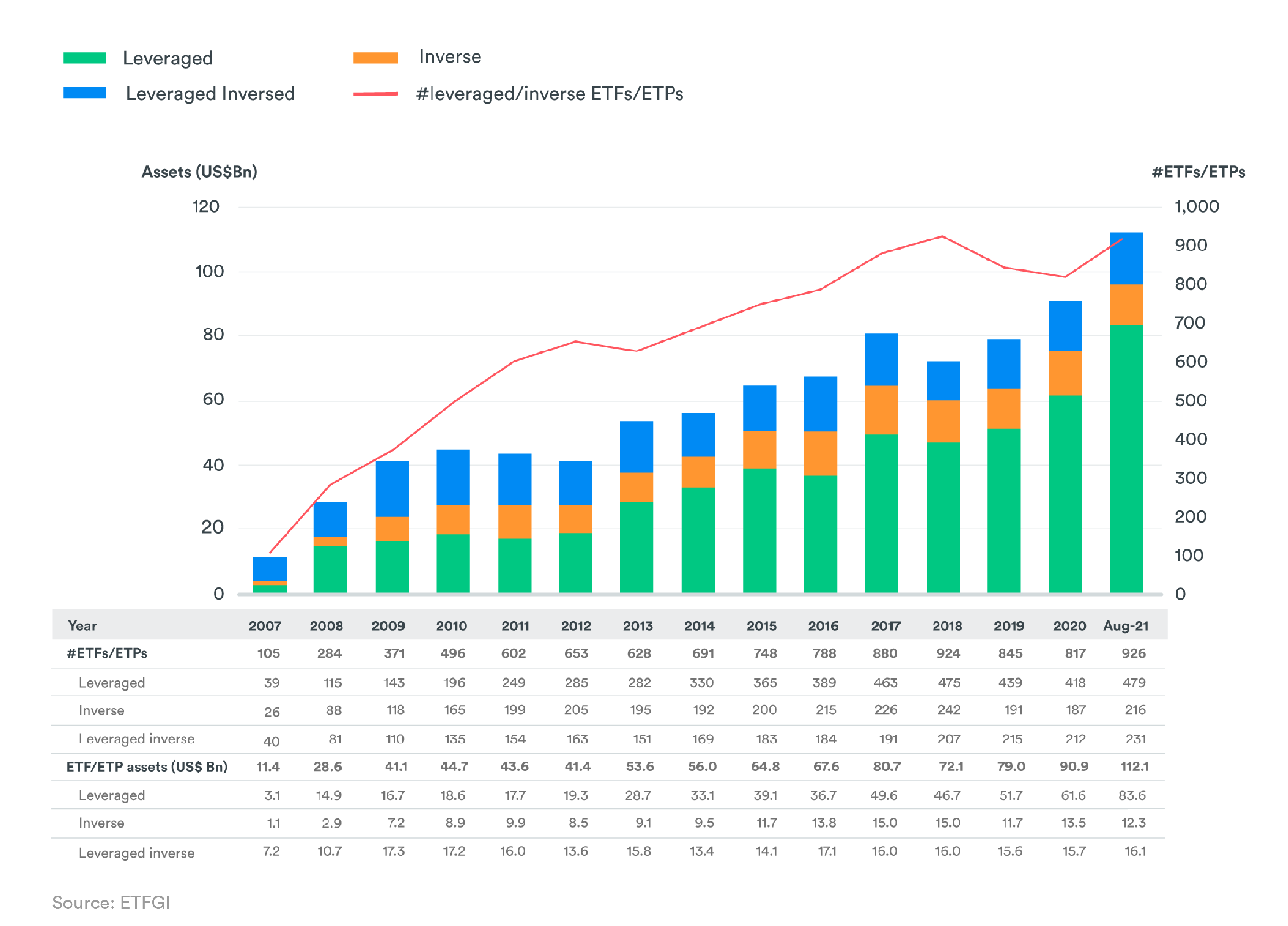
But why?
We know that traditional ETFs have gained traction over the past two decades due to their simplicity, liquidity, and lower fees compared to mutual funds.
With the massive equity bull run since the 2008 Great Financial Crisis (excluding the brief 2020 market crash), it’s no surprise that investors have sought ways to amplify their returns. However, borrowing money to increase leverage isn’t always straightforward. That’s where leveraged ETFs provide an accessible alternative for everyday investors.
A Quick Intro to Leveraged ETFs
Most leveraged ETFs (exchange-traded-funds) achieve their target leverage—typically 2x or 3x the daily returns of an underlying index—through derivatives (usually swaps, futures, and options).
These financial instruments allow the fund to increase its leverage without holding the full value of the underlying assets. Each day, the fund rebalances to maintain its target leverage, adjusting exposure based on the index’s performance.
This daily rebalancing is critical to understanding leveraged ETFs. Unlike traditional ETFs that aim to track long-term index performance, leveraged ETFs deliver a multiple of the index’s daily return. Over longer periods of time, compounding effects and market volatility can cause their performance to deviate from expectations.
In volatile markets, repeated up-and-down movements erode returns due to volatility decay. Now, many people claim that leveraged ETFs are unsuitable for long-term holding due to this effect. But before addressing why this belief may not be entirely accurate, let’s first break down what volatility decay actually is.
Volatility Decay
One downside of LETFs is their expense ratio. At the time of publication, UPRO (a popular 3x S&P 500 LETF) had an expense ratio of 0.91%, compared with 0.0945% for SPY.
While expenses can be higher with LETFs, the main reason why individuals warn investors about them is volatility decay. Volatility decay, or volatility drag, is the reduction in compounded returns caused by fluctuations in the underlying asset relative to a simple multiple of its arithmetic return. It does not mean that a leveraged ETF must lose value over time.
To understand this, let’s start with an interview question that I have been asked in interviews (and one that I have asked myself):
“You buy one share of ETF XYZ at a price of $100. XYZ goes down 10% one day, then up 10% the next day. What is the final price of XYZ?”
Before looking at the answer, take a moment to try it yourself. And yes, 10% daily moves are unrealistic in most cases, but they keep the math simple.
Well, here’s the answer:
$100 * (1 + -0.1) * (1 + 0.1) = $99The ETF ends up at $99, not $100.
This may be intuitive to some of you, but if you’re newer to finance, it might not be. This effect is volatility decay (or drag)—given equal percentage changes (in absolute terms), negative days have a larger impact on returns than positive days.
Now, let’s look at what happens with a 2x leveraged ETF under the same conditions:
$100 * (1 + -0.2) * (1 + 0.2) = $96We lose even more of our initial capital, with a loss of $4 for the 2x leveraged ETF relative to a $1 loss for the traditional ETF (1x leverage).
With 3x leverage, the effect becomes even more pronounced:
$100 * (1 + -0.3) * (1 + 0.3) = $91This is why many people say that leveraged ETFs are not good for long-term holding. However, volatility drag can affect any non-zero exposure to a volatile asset, including 1x, and higher daily leverage magnifies it.
This concept ties into path dependence: over multiple periods, a daily-reset LETF’s cumulative return depends on the daily return path, not just the benchmark’s start and end values. A separate research paper dives deeper into path dependence in LETFs, but for now, let’s focus on this common misconception.
Optimal Leverage
The paper “Alpha Generation and Risk Smoothing Using Managed Volatility” by Tony Cooper investigates the optimal leverage in the financial markets. Here is a brief summary of the paper:
This paper challenges the idea that leveraged ETFs are “un-investable” due to volatility decay, showing that dynamically managing leverage based on volatility can improve risk-adjusted returns. The study finds that 1x leverage is not optimal, as market returns are difficult to predict, but volatility is more forecastable. A 2x leverage ratio is often ideal for stock indices, maximizing returns while controlling for volatility drag. By reducing exposure during high volatility and increasing leverage in low-volatility periods, investors can smooth returns, reduce drawdowns, and outperform static buy-and-hold strategies.
I won’t dive into the second half of the paper here. For now, I want to introduce these ideas as a foundation for investigating leveraged ETF strategies with actual code.