

Reviewed and updated 24 July 2026
Hello!
Welcome to the second and last post in this series. In the last post, I showed how LTCM was exposed to an extreme tail event, how kurtosis appears in markets, and introduced the option Greek Volga.
I also covered research on tail risk and the price investors pay for protection.
Today, I will show where Volga exposure appears across an options chain, how a butterfly can be structured to isolate some of that exposure, and what two academic papers do—and do not—tell us about the opportunity.
Let’s get into it.
The Change in Vega for a Change in Implied Vol
From the last post, Volga (also known as Vomma, Vega Convexity, or DvegaDvol) is the option Greek that represents how much vega changes for a change in implied volatility.
To understand the intuition behind this concept, let’s look at how the Vega profile changes across strike prices as implied volatility (IV) rises or falls. The chart below shows the Vega of options at different strike prices. As you probably already know, the Vega graph looks like a bell curve. However, the shape of this bell curve depends significantly on the current level of IV.
As you can see below, higher implied volatility broadens the vega profile across strikes. Under these assumptions, out-of-the-money options gain vega as volatility rises, while the change near the center is much smaller.
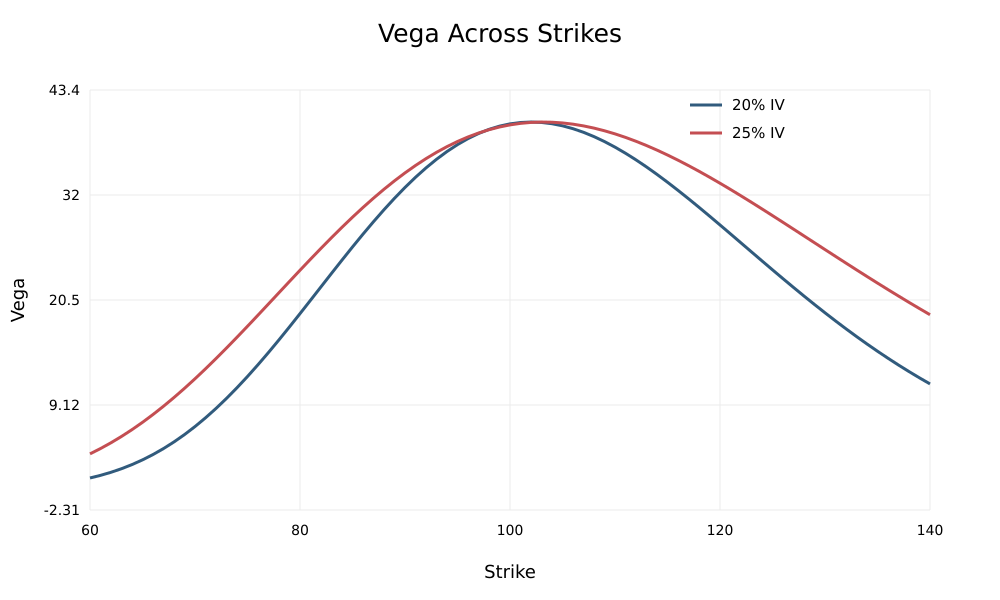
Garman–Kohlhagen vega across strikes for spot 100, one year to expiry, zero rates, and 20% or 25% IV.
I can also view the same idea through Volga, the derivative of vega with respect to implied volatility. Under these assumptions, Volga is positive through much of the wings but slightly negative around the forward/ATM region:
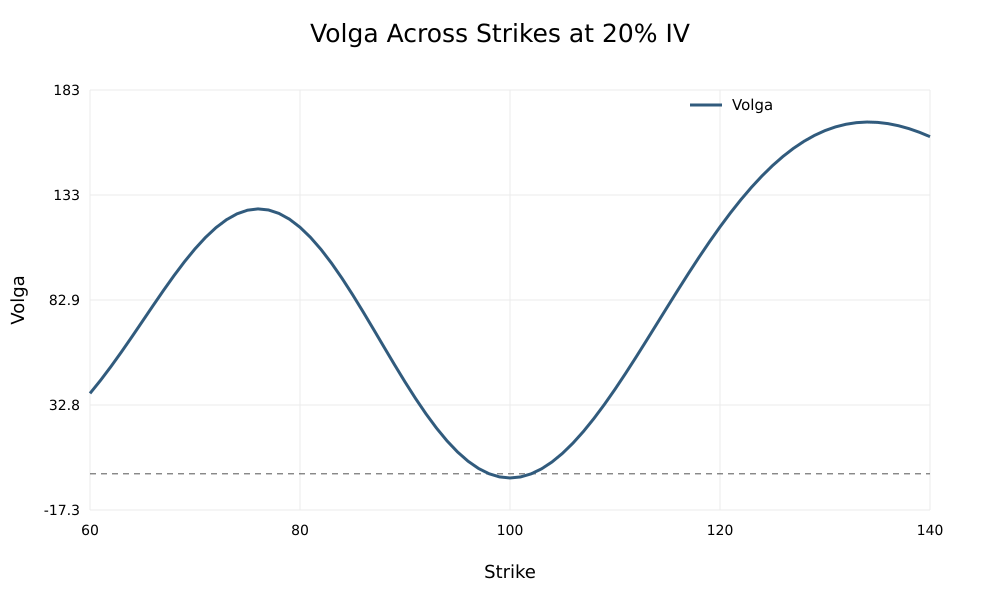
Garman–Kohlhagen Volga across strikes for spot 100, one year to expiry, zero rates, and 20% IV. Volga can be positive or negative.
Some may not have thought about the “why” behind this before, so let’s look at the intuition. The Plinko board example is often a good analogy to explain volatility. Imagine dropping balls (stock returns) from the top of the board. In a low-volatility environment, the pegs are close together, and the balls cluster tightly in the center. Because the outcomes are so predictable, an OTM option (a slot far to the side) feels “impossible,” and it has almost no sensitivity to a change in the board’s width (Vega).
However, as you “crank up” the volatility, you are effectively widening the board and spacing out the pegs. Suddenly, the probability of a ball reaching those far-flung OTM slots isn’t just possible, it’s actually accelerating. This is why OTM options have high Volga: as the underlying has a greater chance of reaching those far out strikes, these “lottery tickets” become much more sensitive to further increases in volatility.
You can test this with an option-pricing model. I like this calculator online because it displays the Greeks clearly. It uses the Garman–Kohlhagen model for FX options rather than the standard equity Black–Scholes setup. The foreign rate plays the same mathematical role as a continuous dividend yield, so with both rates set to zero the examples below reduce to the same zero-rate formulas.
OTM Call
I will use a 15-delta option for this example, as the wings generally house the greatest Volga. I will use a call, but the effect is the same for an OTM put.
Assume USD/JPY is at 100, and I have a one-year call with a strike price of 125. For simplicity, assume zero yield for both currencies. At 20% volatility, the option has a delta of about 0.155 and a vega of about 23.82. The calculator quotes vega for a one-unit change in volatility; divide by 100 for the approximate effect of a one-percentage-point IV change.
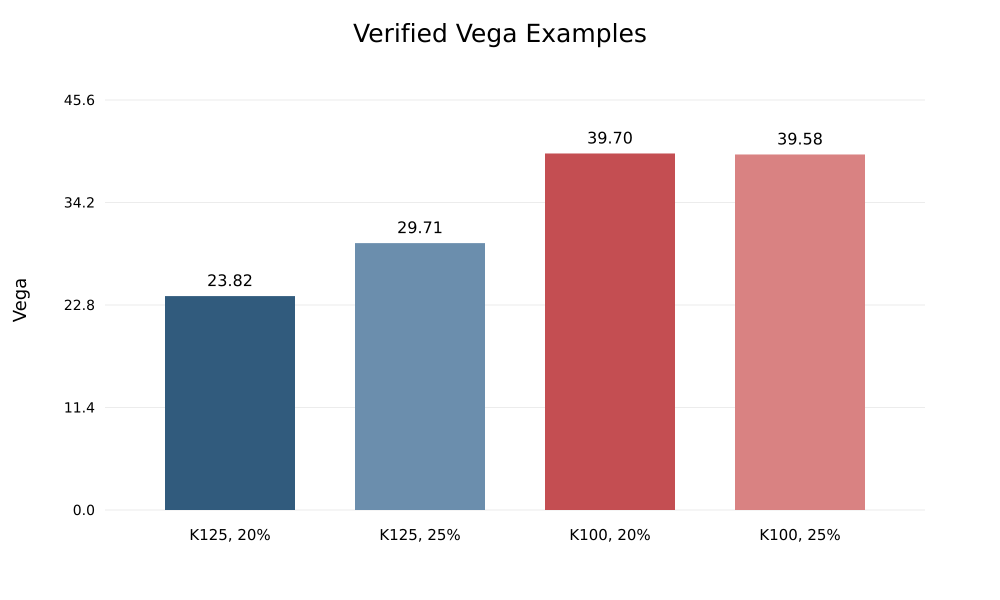
Verified vega values for the article’s four Garman–Kohlhagen examples. Spot is 100, expiry is one year, and both rates are zero.
When I increase implied volatility to 25%, the vega rises to about 29.71:
This is the vega convexity that benefits a long out-of-the-money option in this particular scenario: as volatility rises, its vega grows. Positive Volga is still a local sensitivity, not a promise of profit. The outcome also depends on how far volatility moves, the path of spot and the surface, time decay, hedging, and the premium paid.
ATM Call
I also want to highlight a caveat that is easy to miss. While people often say that all long options have positive Volga, this is not true at every strike.
Theoretically, ATM options can actually have slightly negative Volga.
Using the same assumptions as before but moving the strike to 100 (ATM) and setting volatility at 20%, vega is 39.70.
If I increase implied volatility to 25%, vega actually falls slightly to 39.58.
The reason is visible in the formula Volga = Vega × d1 × d2 / σ. At the exact ATM strike in this zero-rate example, d1 is positive and d2 is negative, so their product—and therefore Volga—is slightly negative.
This is a narrow model result, not a rule that every market convention labelled “ATM” must produce the same sign. Forward ATM, spot ATM, rates, dividends, expiry, and the live volatility surface all affect the calculation.
The Delta-Hedged, Vega-Neutral Butterfly
A standard long butterfly is a common “retail” structure used to bet on low volatility or a “pin” at a specific price. It is constructed by buying one In-the-Money (ITM) call, selling two At-the-Money (ATM) calls, and buying one Out-of-the-Money (OTM) call.
You can also structure this as an Iron Butterfly using both puts and calls to achieve the same risk profile while potentially managing capital requirements differently.
However, a standard butterfly is not a pure Volga trade. It can carry delta, vega, gamma, vanna, skew, and time-decay exposure. Its exact sensitivities depend on the strikes, ratios, expiry, and volatility surface.
An initially vega-neutral butterfly:
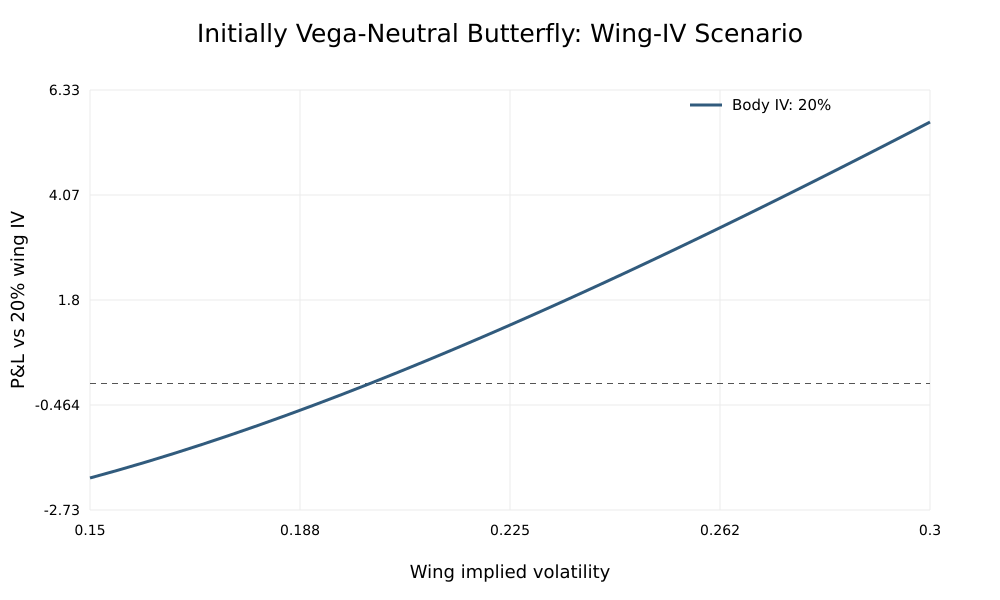
Illustrative wing-IV scenario for a butterfly that is vega-neutral at inception. Spot and the body’s IV are held fixed; this is not a full P&L model or backtest.
If I want to focus on the shape of the volatility surface rather than a simple parallel move in IV, I can adjust the butterfly ratios and hedge the underlying. This is one way a professional desk might structure an exposure to smile curvature.
By adjusting the long wings relative to the short body, I can set the position’s model vega to zero at inception. I can also trade the underlying to set its initial delta to zero. Because the wing options and body have different Volga, the resulting position can retain exposure to changes in smile curvature.
For example, with spot 100, one year to expiry, and 20% IV, buying one 80-strike call and one 120-strike call while selling about 1.203 of the 100-strike call makes the initial Black–Scholes vega zero. The option position still has delta, so an initial stock hedge is also required.
If wing implied volatilities rise relative to the body, that position can gain in the simple scenario shown above. But the hedge is only local: spot moves, time passes, and the surface changes. Gamma, vanna, skew dynamics, rebalancing, transaction costs, liquidity, and model error all remain. The structure does not deliver pure tail-risk P&L or protection from every ordinary price move.
Below, I will connect this structure to two academic papers and explain where the evidence is relevant—and where it stops.