

Hello and welcome back to another paid post!
On 20 April 2020, West Texas Intermediate settled at minus $36.98 a barrel as storage at Cushing filled to the brim and long contract holders paid buyers to take physical oil off their hands.
It was reported as a curiosity of storage economics, and it was. But it also quietly broke something. If you were pricing an option on a refining margin that week using the standard toolkit, the model did not give you a bad number. It gave you no number at all.
Today we will look at what you use instead. There are three approaches: one that is exact but narrow, one that is approximate and lives on every commodities desk in the world, and one brute-force method that makes no assumptions at all. Along the way we will find something sharper than any of them.
Let’s dive right in.
The Spread That Runs a Refinery
A refinery is, financially speaking, a machine that converts one commodity into two others. It buys crude oil and sells gasoline and distillate. What it earns is not the price of any of those three things, but the gap between what it sells and what it buys.
The industry has a shorthand for this: the 3:2:1 crack spread. For every three barrels of crude a typical US refinery processes, it yields roughly two barrels of gasoline and one of distillate. So the margin per barrel of crude run is
with one bookkeeping detail. Crude is quoted in dollars per barrel; refined products are quoted in dollars per gallon. Nothing means anything until the products are multiplied by 42.
That number is what a refiner actually earns, and therefore what a refiner actually wants to hedge. Which is why options on it exist, and why we need something to price them with.
All three legs are published daily by the EIA and are free to pull back to 1986: WTI at Cushing for crude, New York Harbor gasoline and heating oil for the products. Requiring all three to print on the same day gives us 10,080 trading days spanning forty years.
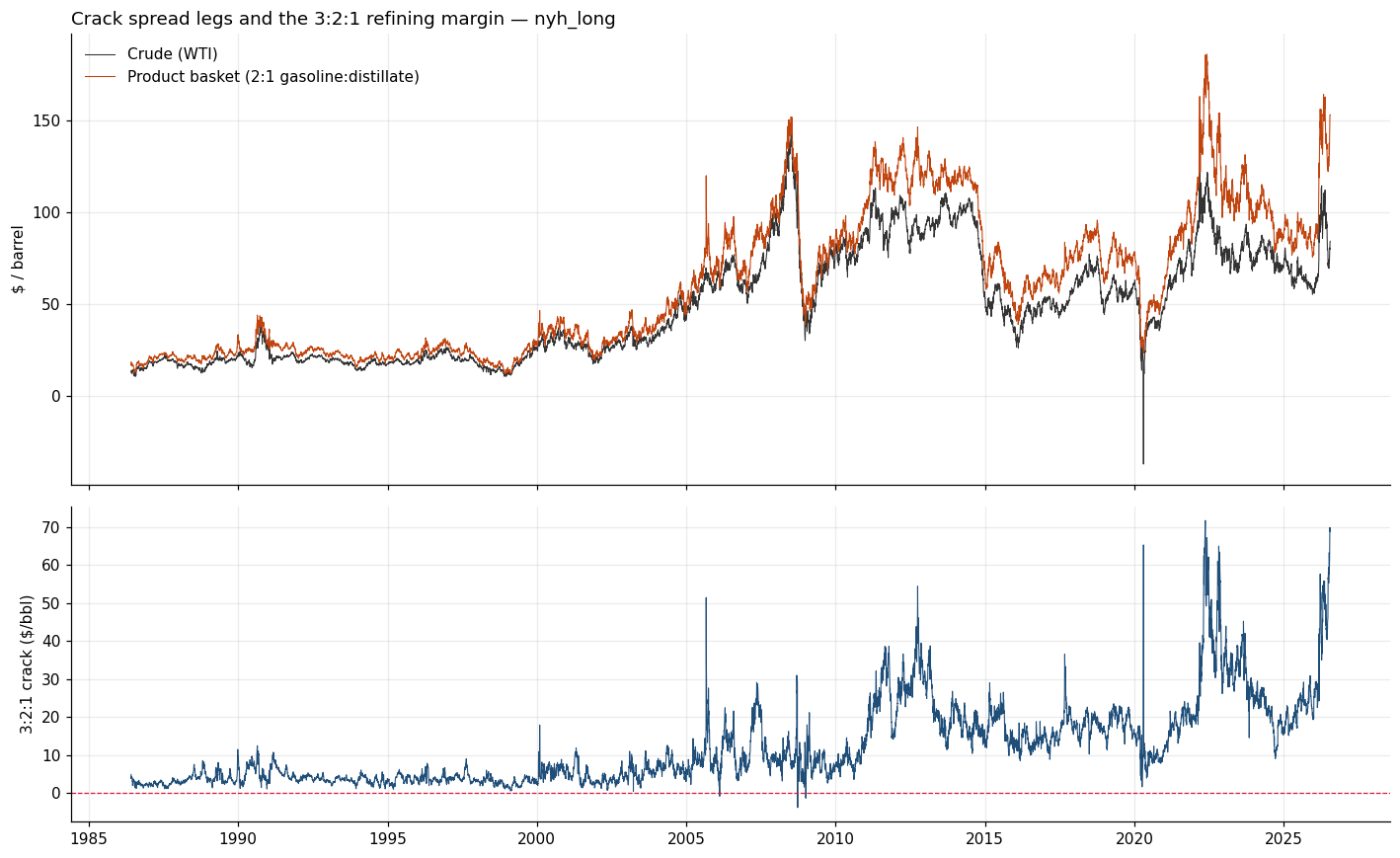
Figure 1: The legs and the margin, 1986–2026. Crude and the product basket track each other closely. The gap between them is what the option is written on.
Over the full sample the margin averages $12.11 per barrel, with a median of $7.86, ranging from −$3.72 to $71.74. It has been negative on 5 days out of 10,080, about 0.05% of the time. Which makes sense, since refiners shut down when processing crude loses money.
But notice that it can go negative, and the entire reason why there is a problem with standard pricing methods.
Why Black-Scholes Cannot Price This
The instinct is to treat the crack spread as an asset like any other: Feed it into Black-Scholes, and get on with your day.
However, Black-Scholes assumes the underlying asset is lognormal, which makes the mathematics tractable, but rests on the assumption that prices compound multiplicatively and cannot fall below zero.
A spread is the difference of two lognormals. And the difference of two lognormals is sadly not lognormal. There is no change of variables that makes it so. Thus, no lognormal variable can go below zero. But history shows that our spread has been negative before. Because you can’t take the logarithm of a negative number, Black-Scholes would actually return nothing.
So we need machinery built for two assets from the beginning.
Method One: Margrabe (1978)
William Margrabe solved a specific version of this problem in 1978, and the trick is worth understanding even if you never use the formula, because it explains why these options behave the way they do.
Consider an option to exchange one asset for another: the right to give up asset 2 and receive asset 1. Its payoff is max(S1−S2, 0), a spread option with a strike of exactly zero.
Margrabe’s move is to stop pricing in dollars and price the option in units of S2 instead. The payoff becomes:
which is an ordinary call option on the ratio struck at 1.
And here is the point. The difference of two lognormals is not lognormal, but the ratio of two lognormals is. Black-Scholes applies exactly, with an effective volatility of
The correlation between the two legs enters the price directly, and it enters with a negative sign. Higher correlation means lower effective volatility, which means a cheaper option.
Two assets that move together produce a spread that barely moves, and an option on something that barely moves is not worth much. Push correlation toward 1 and the spread flatlines. Push it toward −1 and the spread whips around violently. The option price follows.
Which raises an uncomfortable question we will return to at the end: if correlation is baked this deeply into the price, how confident are you in the number you are using for it?
But first, there is a catch, and it is a serious one. Margrabe’s trick works only at a strike of exactly zero. Put a real strike K on the option and the payoff in units of S2 becomes
and K/S2 is random. The strike stops being a constant, the ratio is no longer a clean call option, and the closed form collapses.
Margrabe is exact. It is also, for most real options, unusable.